
Ada is one of the more established names in AI-powered customer service. Its Reasoning Engine, omnichannel coverage across chat, email, voice, and SMS, and enterprise customer base make it a credible option for large support organizations looking to automate high-volume interactions.
But Ada's enterprise-only positioning, opaque pricing, and implementation timeline won’t suit every team. And even teams that fit the profile can run into friction. Process execution still relies on careful prompt configuration, knowledge ingestion doesn't cover all your sources, and the billing model charges per conversation whether the AI resolves the issue or not.
This article covers the best Ada alternatives for support teams, comparing capabilities, pricing models, and tradeoffs so you can find the platform that fits your operational needs and team structure.
Shortcomings of Ada
Ada is a good product with solid enterprise credentials, but tradeoffs in pricing, process configuration, and knowledge coverage lead teams to evaluate alternatives.
Process Execution Still Depends on Prompts
Ada's Playbooks are more structured than raw prompts, but the underlying model is the same. Your team configures instructions that tell the AI how to behave. As processes involve more branching logic, conditions, and exception paths, setup gets complicated and updates require careful reconfiguration and testing. There's a practical ceiling on how much complexity prompt-based configuration can reliably handle.
Maintenance Creates a Separate Track for Your AI
Configuring Playbooks creates a parallel set of process documentation that lives separately from how your human agents work. Your team maintains SOPs for reps and separately maintains Playbook configurations for the AI.
When your business changes, both need updating, and making changes often requires close collaboration with Ada's team.
Conversation-Based Billing Adds Up
Ada charges per conversation, not per resolution, so you pay even when the AI escalates to a human. Third-party estimates start around $30K/year, scaling with volume. Ask whether you're being quoted per-resolution or per-conversation, as the distinction changes the economics meaningfully.
Knowledge Ingestion Has Gaps
Ada cannot natively ingest PDFs, past ticket conversations, or content from tools like Notion. For teams whose institutional knowledge lives across multiple formats and systems, this limits what the AI can draw from without workarounds.
With these limitations in mind, here are some alternatives worth evaluating.
Best Ada Alternatives at a Glance
| Best For | |
| Stonly AI Answers | Support teams that need AI built on structured, process-driven knowledge, where the AI follows documented processes step by step rather than interpreting prompts, and your team can update workflows without engineering help |
| Decagon | Enterprise teams that want a newer, LLM-native AI agent platform with strong action execution and a dedicated implementation team willing to build alongside you |
| Zendesk AI Agents | Support teams already on Zendesk that want to add AI automation natively without managing a separate vendor relationship |
| Cognigy (NiCE Cognigy) | Large contact centers that need enterprise-grade conversational AI across voice and digital channels with extensive IVR, workflow automation, and contact center infrastructure integration |
| Sierra | Enterprise brands that want a fully managed, bespoke AI agent with outcome-based pricing and tight CRM integration, and have the budget and team to support it |
| Chatbase | Support teams that want AI agents to resolve requests through connected actions and defined procedures, with a built-in Helpdesk for human support |
Stonly AI Answers
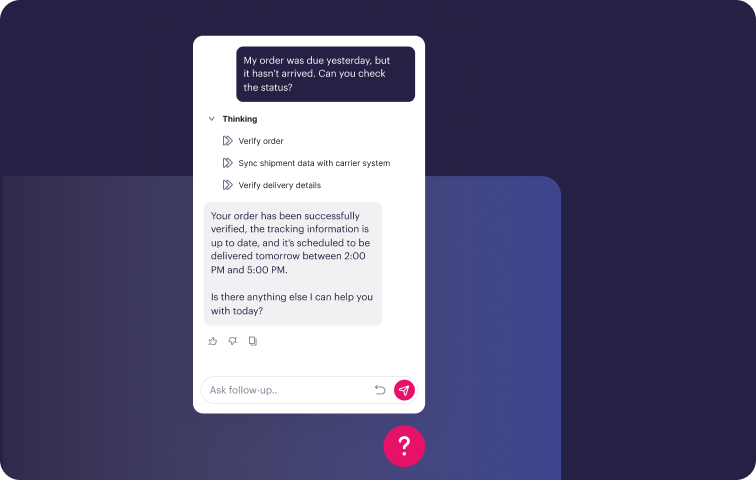
Stonly is a knowledge platform with AI capabilities built for customer service teams. Ada and similar tools lead with an AI agent that you configure through prompts and instructions. Stonly leads with the knowledge itself, built as structured, step-by-step content that your human agents, customers, and AI all work from.
AI Answers, Stonly's conversational AI capability, uses that structured foundation to resolve everything from straightforward questions to complex multi-step issues across chat, email, and WhatsApp, with no prompt configuration required. It works for both customer self-service and as an internal knowledge tool for support reps, giving teams a single AI layer wherever answers are needed.
Build AI on Structured Knowledge, Not Configured Prompts
Ada's Playbooks tell the AI what to do through configured instructions. Stonly's AI Answers draws from structured, metadata-rich content. That includes standard articles alongside interactive guides that branch and adapt based on what the user needs. Teams can also connect external knowledge sources (Zendesk Guides, Google Docs, and other company content), so existing documentation works alongside Stonly's structured format.
A single guide handles dozens of scenarios by identifying what the user needs and routing them to the matching path. That structure helps AI return accurate answers in conditional, multistep situations where AI working from flat content or long prompts tends to falter.
Resolve Complex Issues End-to-End With Business Process Agents
Stonly's Business Process Agents (BPAs) go a step further than simple Q&A. They walk through your documented processes step by step, collecting information, evaluating conditions, and executing actions in backend systems to fully resolve the issue.
Because BPAs run on the same guides your human agents follow, there's a single shared process layer for how processes work, not a separate configuration layer for the AI.
BPAs execute only approved, scoped actions and follow each step with precision. They leave no room for improvisation or black-box prompt interpretation. To change how a process works, you can simply edit the guide. The AI picks up the change immediately, with no re-engineering or regression testing.
Work Inside Your Existing Help Desk
Stonly connects to Zendesk, Salesforce, Freshdesk, and ServiceNow. Guides load inside the ticket view, pull case data to skip or pre-fill steps, and push updates back when an agent completes a workflow.
AI Agent Copilot reads the open ticket, identifies the applicable workflow, drafts a response, and handles backend steps when appropriate. Reps can review and approve before any action fires, which adds a human-in-the-loop layer for sensitive scenarios. This works across all four help desks.
The same conversational AI interface also deploys in Slack for internal teams. AI Answers powers both customer self-service and internal rep-facing knowledge, so teams can start with either use case or run both.
Organizations that add Agent Copilot get AI-drafted responses and backend actions directly within the ticket view as well. Both capabilities draw from the same structured knowledge.
Keep Content Accurate Without Manual Audits
Stonly's AI Knowledge Agents scan your ticket stream and source material continuously, surfacing gaps, contradictions, and outdated content before they cause problems. Version control, review cycles, and content health scoring give your team a clear queue of what needs attention.
With Ada, keeping AI behavior current means going back into Playbook configurations, reconfiguring, and testing. With Stonly, it means editing the content your team already maintains.
What Stonly AI Answers Offers Over Ada
- AI that follows structured guides instead of configured prompts. BPAs execute processes with the same step-by-step precision your human agents use. No prompt engineering, no context window constraints, no regression testing after every policy change.
- One source of truth for people and AI. Your agents and your AI work from the same guides. No parallel documentation, no dual maintenance burden.
- Wider knowledge coverage. AI Answers connects to external sources alongside Stonly's structured content. No gaps around PDFs, historical tickets, or third-party tools.
- Proactive content maintenance. Knowledge Agents flag what's stale or missing. Ada's model waits for your team to notice and reconfigure.
- Better accuracy on conditional, high-complexity tickets. Structured, metadata-rich guides help AI differentiate between scenarios that flat content or long prompts tend to blur together.
Things to Consider
- Not a drop-in replacement for an AI agent platform. Stonly's AI Answers lives within a knowledge platform. It won't fully replace human support on its own. If full automation is the primary goal, Stonly isn't positioning itself as that solution, and it's built to work alongside your support operation.
- No voice channel. Ada supports voice through its Reasoning Engine. Stonly's AI Answers covers chat, email, and WhatsApp, but voice isn't available today. For teams where phone is a major channel, that's a meaningful gap.
What Real Customers Are Saying About Stonly
“Our customers love getting instant, interactive help rather than searching through a long text document. It’s a big deal because no one else in our industry has anything like this at the moment. So we’re leading the charge.”
Justin Wilder, Service Coordinator Manager, Anderson America
Tonal saw a 62% lift in workforce adherence, 90% overall QA score, and 7% increase in agent CSAT scores after implementing Stonly.
Pricing
Custom pricing available upon request.
See how AI Answers would handle one of your support processes. Get a demo →
Decagon
Decagon is an LLM-native AI agent platform designed specifically for customer service automation. Its Agent Operating Procedures (AOPs) let teams define how the AI handles specific scenarios using natural language instructions that compile into code. The AI takes real actions (processing refunds, updating accounts, verifying identity) across chat, email, and voice, and the platform includes a dedicated implementation team (Agent Product Managers and Forward-Deployed Engineers) that builds alongside you.
Decagon's differentiator is depth of action execution. The platform connects to backend systems and takes multi-step actions within conversations, rather than answering questions from a knowledge base. For a more detailed comparison, see our guide to the best Decagon alternatives.
What Decagon Offers Over Ada
- LLM-native architecture designed for AI-first customer service, rather than a legacy chatbot platform that evolved into an AI agent. AOPs compile natural language into code for more predictable execution.
- Dedicated implementation team (APMs and FDEs) that build and deploy alongside you, rather than handing you a platform to configure on your own.
- Voice support with sub-second latency, branded caller IDs, and SIP trunking. The offering is newer to market but architecturally current compared to Ada's voice product.
Things to Consider
- Agent Assist limited to Zendesk. Decagon's AI copilot for human agents currently only works in Zendesk. Ada's platform works as an overlay on 13+ help desks, giving it far broader agent-facing coverage.
- Implementation dependency. The hands-on implementation model is valuable at setup but creates ongoing reliance on Decagon's team. G2 reviewers note that building and tuning AOPs often requires an internal "Agent Engineer" or close vendor collaboration.
- Prompt-based process execution shares Ada's ceiling. AOPs use a different mechanism than Ada's Playbooks, but the core architecture is similar. Natural language instructions become harder to maintain as processes grow more complex.
Pricing
Custom, quote-based pricing. Usage-based billing on top of platform fees. No published rates.
Zendesk AI Agents
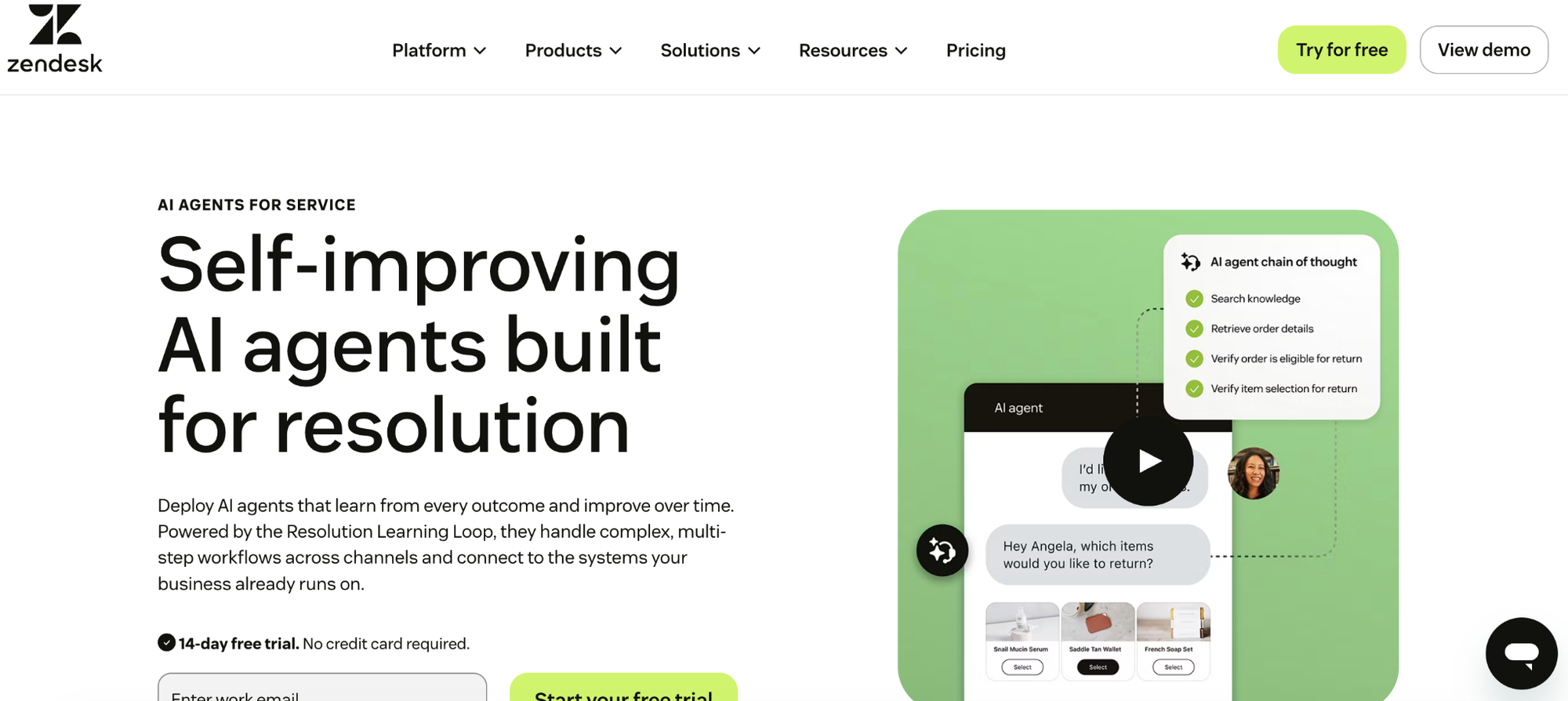
Zendesk AI Agents are the native AI automation layer built into Zendesk's support platform. The core value proposition is zero friction for existing Zendesk teams. There’s no separate vendor, no additional integration, and the AI draws directly from your Zendesk Guide content. Agent Builder gives CX teams a no-code tool to create custom AI workflows, and the AI supports messaging, email, and voice in 80+ languages.
What Zendesk AI Offers Over Ada
- No additional vendor relationship for existing Zendesk teams. The AI agent is native to the platform, eliminating the integration overhead Ada requires as an overlay.
- No-code Agent Builder lets CX teams create, test, and deploy custom AI workflows without engineering support or multi-month implementation timelines.
- More transparent pricing structure, though costs layer on top of each other (Suite + Copilot + per-resolution AI billing).
Things to Consider
- Costs stack up in layers. Zendesk Suite runs $55-$115/agent/month, the Copilot add-on is ~$50/agent/month, and AI resolutions bill at roughly $1.50-$2.00 each. A 20-agent team resolving 3,000 AI conversations per month can realistically spend $80K+/year all-in.
- Platform lock-in. Zendesk AI Agents only work within Zendesk. If you ever migrate to Salesforce, Freshdesk, or another help desk, the AI layer doesn't come with you. Ada works as an overlay across 13+ platforms, making it more portable.
- AI is only as good as your existing content. Zendesk AI draws from your Guide articles, so resolution quality depends on how current and well-structured your help center content is. If your articles are outdated, unstructured, or incomplete, the AI's resolution quality will reflect that. There's no built-in mechanism to proactively identify knowledge gaps or flag stale content.
- Automatic overage billing. Zendesk introduced auto-billing for AI resolution overages in January 2026, with limited advance notice, which has caught some teams off guard during volume spikes.
Pricing
Zendesk Suite: $55-$115/agent/month. Copilot add-on: ~$50/agent/month. AI Agent resolutions: ~$1.50-$2.00 per resolution (usage-based).
Cognigy (NiCE Cognigy)
Cognigy is an enterprise conversational AI platform built specifically for contact centers. It combines generative AI with traditional conversational AI (intent recognition, dialog management, flow design) to automate customer interactions across both voice and digital channels.
The platform includes AI agents for self-service, an agent copilot, intelligent IVR, and deep integration with contact center infrastructure (ACD, telephony, workforce management).
What Cognigy Offers Over Ada
- More extensive voice and IVR capabilities, built from a contact center foundation rather than added on top of a chat-first platform. For teams where phone is a primary or high-volume channel, Cognigy's voice architecture is more mature.
- Forrester Wave Leader (Q2 2026), recognized for enterprise-ready capabilities, strength of strategy, and customer feedback. Ada was included in this evaluation but was not named a Leader.
- On-premises and private cloud deployment options for organizations with data sovereignty or compliance requirements that prevent using a fully hosted SaaS platform.
Things to Consider
- The NICE acquisition changes the calculus. For teams not already on NICE CXone, this introduces questions about long-term platform independence, pricing bundling, and whether Cognigy will continue to operate fully as a standalone option.
- Enterprise commitment with enterprise pricing. Third-party estimates place annual contracts at $115K-$300K+, with separate charges for voice, chat, and LLM workloads. Add-ons like Agent Copilot and Knowledge AI are billed on top.
- Implementation complexity. Cognigy's flow-based builder is powerful but comes with a learning curve. Full enterprise deployments require meaningful setup time and often involve professional services.
- Better suited for teams with contact center infrastructure. Cognigy's strengths (IVR, telephony integration, workforce management hooks) are most valuable for traditional contact centers. Support teams running primarily digital channels without heavy voice volume may not need this level of infrastructure.
Pricing
Custom, quote-based pricing. Separate billing for voice, chat, and LLM workloads. No published rates.
Sierra
Sierra is a standalone AI agent platform that positions itself as an "Agent Operating System" rather than a help desk add-on. Its agents take real actions (processing returns, updating subscriptions, verifying identity) and deploy across chat, voice, SMS, WhatsApp, and email.
The platform combines generative AI for natural conversation with deterministic logic for business rules, reducing hallucination risk on sensitive operations. Sierra operates as a fully managed service. The vendor builds, deploys, and optimizes the agent for you, targeting large enterprises (roughly 40% of the Fortune 50).
What Sierra Offers Over Ada
- Outcome-based pricing where you pay per successful resolution, not per conversation. For teams with lower resolution rates, this can be more cost-efficient than Ada's conversation-based billing.
- Fully managed service model where the vendor builds and operates the agent. For teams that want a hands-off approach and have the budget, this eliminates the internal resources Ada requires for Playbook configuration and maintenance.
- Deeper voice capabilities following the Receptive AI acquisition, including inbound/outbound calls across channels.
Things to Consider
- Even more expensive than Ada. Third-party estimates place year-one costs at $200K-$350K+. This is a premium, fully managed service designed for the largest enterprise buyers.
- The managed service model reduces team autonomy. Sierra builds and operates the agent for you. That's a feature for teams that want a hands-off approach, but a limitation for teams that want to own and iterate on their AI workflows internally.
- Not built for mid-market. Sierra explicitly targets large enterprises. Half of its customers have revenue exceeding $1B. There's no self-serve option, no trial, and no mid-market entry point.
- Still maturing on legacy system connectivity. The Forrester Wave (Q2 2026) named Sierra a Strong Performer but flagged weaker legacy-system connectivity and live-agent escalation compared to incumbent contact center vendors.
Pricing
Custom, quote-based pricing. Outcome-based billing (per successful resolution) plus platform subscription. No published rates.
Chatbase
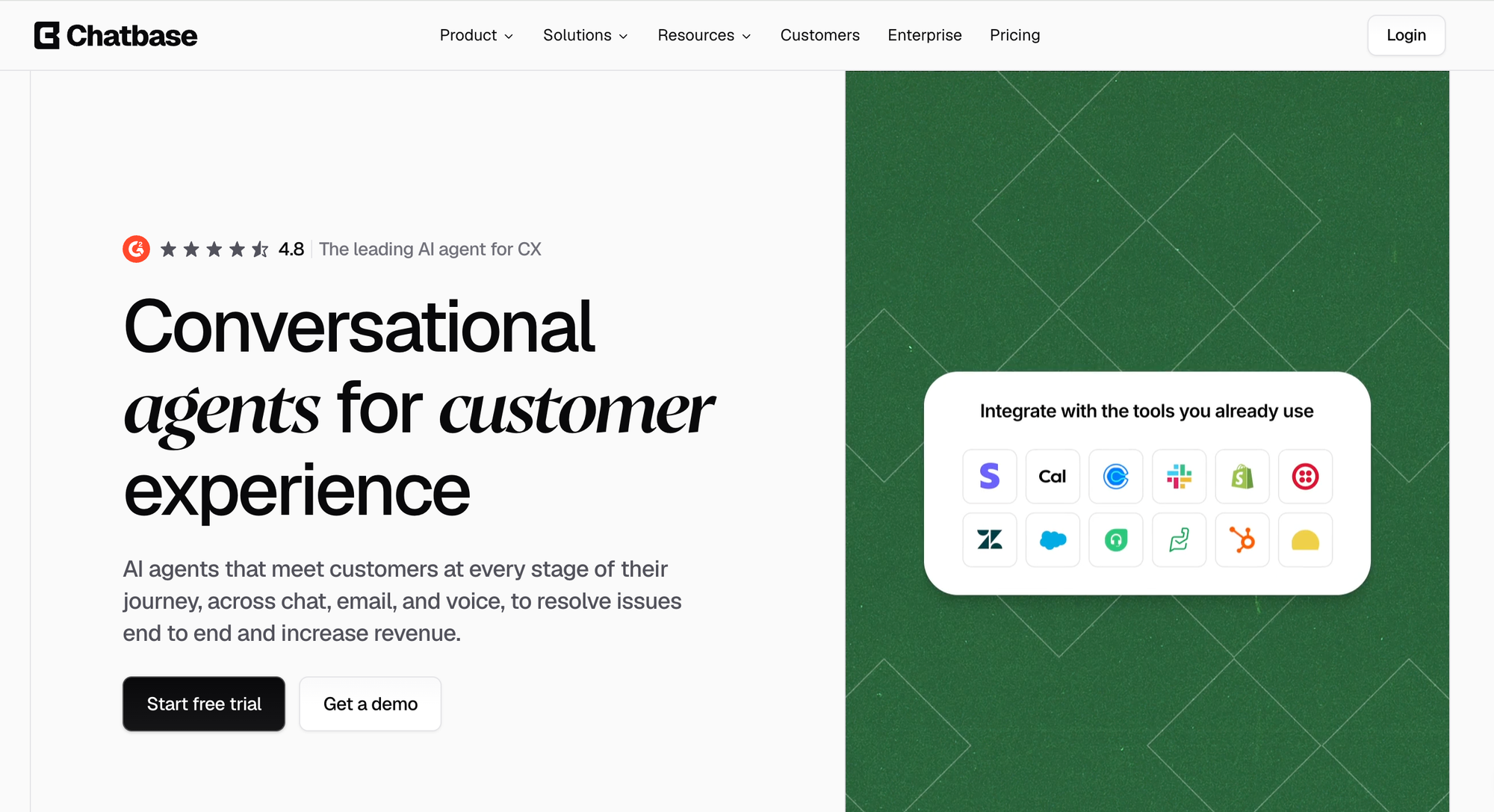
Chatbase is an Ada alternative for support teams that need AI agents to answer customers, retrieve account information, and complete tasks in connected systems. It combines answers from company knowledge with Actions and Procedures for multi-step requests across chat, email, messaging, and voice. Teams can manage human handoffs in its built-in Helpdesk or connect an existing support tool.
Procedures give teams control over the steps behind a resolution. A workflow can require identity verification, retrieve order or billing data, check eligibility, and determine whether the agent should complete an action or request approval. Teams can inspect execution traces and rerun saved scenarios after changing a policy.
For ecommerce support, native Shopify Actions cover product discovery, cart updates, order creation, tracking, eligible returns and refunds, and exchanges. An agent can process an eligible return on an existing order or prepare a new exchange order for human approval. Widgets can display product cards, forms, and order details within the conversation.
What Chatbase Offers Over Ada
- AI agents and a built-in Helpdesk: Teams can assign and take over escalated conversations in Chatbase, keeping automated and human support in one workflow. Supported integrations also let teams retain their existing helpdesk.
- Interactive customer experiences: Widgets let customers view products, submit information, and interact with order details inside a conversation.
- Native Shopify workflows: Agents can connect shopping assistance with post-purchase tasks, including eligible returns, refunds, exchanges, and replacement orders.
- Published pricing: Monthly plans include defined message-credit allowances, while enterprise deployments use custom pricing. Teams can evaluate the product through a free plan or paid trial.
Things to Consider
- Teams need to configure Actions and Procedures around their systems and policies, then test sensitive workflows before deployment.
- Plan allowances vary. Helpdesk, voice, and API access start on Standard; tickets as a knowledge source and advanced analytics start on Pro.
Pricing
Enterprise pricing is custom. Published monthly plans include Hobby at $40 with 700 message credits, Standard at $150 with 4,000 credits, and Pro at $500 with 15,000 credits. A free plan includes 50 credits per month. Chatbase uses subscriptions with message credits rather than a published per-resolution fee.
Consider a Knowledge-First Approach to AI-Powered Customer Service
Ada and most alternatives on this list are capable AI agent platforms, but they share a common architecture. The AI's ability to resolve complex issues depends on prompt engineering, Playbook configuration, or compiled instructions.
Maintaining those configurations requires specialized skills and ongoing vendor collaboration. When processes change, you're re-engineering prompts and testing for regressions.
Stonly's AI Answers is built on a different foundation. The AI works on top of structured knowledge and documented processes that your team already maintains for human agents. Business Process Agents follow those processes step by step, handling branching logic, conditional actions, and backend integrations without prompt engineering. When something changes, you update the guide, and the AI follows the updated process immediately.
For support teams evaluating AI for customer-facing resolution, the platform question matters, but so does the process question: how do you want to build and maintain the processes your AI follows, and who on your team can own that work?
See how Stonly's AI Answers would handle your support processes. Request a demo →