

The best integration platforms for AI agents in 2026 are Composio, Albato Embedded, Nango, Pipedream Connect and Arcade, followed by Merge Agent Handler, Paragon ActionKit, Workato Enterprise MCP, StackOne and Zapier MCP. They differ on three things: how many apps an agent can reach out of the box, how much control developers keep over each tool, and how strictly the platform governs what an agent is allowed to do on a user's behalf.
Imagine any AI agent that operates across your business systems: reading data, updating records, triggering notifications, or automating workflows. That could mean pulling customer data from a CRM, checking status in a helpdesk system, updating leads, posting to Slack, or pulling data from a data warehouse. Every platform below exists to make that kind of agent work, which is a narrower job than classic workflow automation. The problem they share is specific: an AI agent needs to call real APIs (read a record, update data, post to a channel) with the right user's credentials, through a tool definition the model can understand, and with a record of what happened afterwards. That means tool calling, MCP servers, managed OAuth, per-user credentials, action catalogs, permissions and audit logs. Platforms that only added an AI step to a trigger-action builder didn't make the cut.
Key takeaways: Composio has one of the broadest agent-native catalogs (1,500+ apps) and the most generous published free tier, which makes it the default starting point for teams wiring tools into their own agent. Albato Embedded fits SaaS companies that need to ship agent integrations to their own customers under their own brand. Nango and Paragon suit teams that want code-level control, while Arcade, Merge, Workato and StackOne lead on permissions, identity and audit.
How we picked
We sorted every candidate into one of three categories, because the right platform depends far more on the problem you have than on catalog size alone.
Broad app catalog platforms give an agent the widest reach with the least setup. You connect once, and the agent can discover and call hundreds or thousands of prebuilt actions.
Developer control platforms treat integrations as code you own. They handle the painful parts (OAuth flows, token refresh, rate limits) but let your engineers define, version and test each action. They take longer to set up but are harder to outgrow.
Enterprise governance platforms focus on who the agent acts as and what it may touch. Expect user-level authorization, scoped tool access, audit trails and data controls, usually priced for larger organizations.
For each vendor, we checked the current agent product on its own site in September 2026 and listed pricing only where the vendor publishes it.
The order within the list weighs how many apps an agent reaches through one connection, how much of the auth and end-user connection work the platform takes off your team, and whether pricing is published. Category tells you which platforms fit your case; rank tells you where we would start within it. This list covers the integration layer: what an agent can reach and how it authenticates. It doesn’t rank the chat clients and workspaces that call these tools, such as Claude, ChatGPT, Cursor, or governed, open-source team workspaces like Grengin.
Quick comparison table
Composio. Category: Broad app catalog. MCP support: Yes. Auth handling: Managed OAuth, API keys, token refresh. Starting price: Free (100,000 tool calls/mo); Pro $29/mo.
Albato Embedded. Category: Broad app catalog, embedded and white-label. MCP support: Yes (Universal MCP). Auth handling: Managed authentication, credentials isolated per end user. Starting price: Starter from $3,000/mo; Universal MCP on Pro from $5,000/mo.
Nango. Category: Developer control. MCP support: Yes. Auth handling: OAuth, API keys, token refresh. Starting price: Free; $50/mo + usage.
Pipedream Connect. Category: Broad app catalog. MCP support: Yes (remote MCP server). Auth handling: Hosted OAuth, per-user credential isolation. Starting price: Free in development.
Arcade. Category: Enterprise governance. MCP support: Yes (plus custom MCP). Auth handling: User authorization, agent acts within user scope. Starting price: Free; Team $25/mo + usage.
Merge Agent Handler. Category: Enterprise governance. MCP support: Yes (built on MCP). Auth handling: Per-user credentials via guided flow. Starting price: Free (2,000 credits/mo); Pro $1,000/mo.
Paragon ActionKit. Category: Developer control, embedded. MCP support: Yes. Auth handling: Managed end-user auth in your product. Starting price: Custom quote.
Workato Enterprise MCP. Category: Enterprise governance. MCP support: Yes. Auth handling: Verified User Access, inherits user identity. Starting price: Custom.
StackOne. Category: Enterprise governance. MCP support: Yes (every connector). Auth handling: Managed OAuth, SAML, API keys, scopes. Starting price: Free Gateway Starter.
Zapier MCP. Category: Broad app catalog. MCP support: Yes. Auth handling: Credentials kept in Zapier's connection layer. Starting price: Included in every Zapier plan.
1. Composio
Category: Broad app catalog
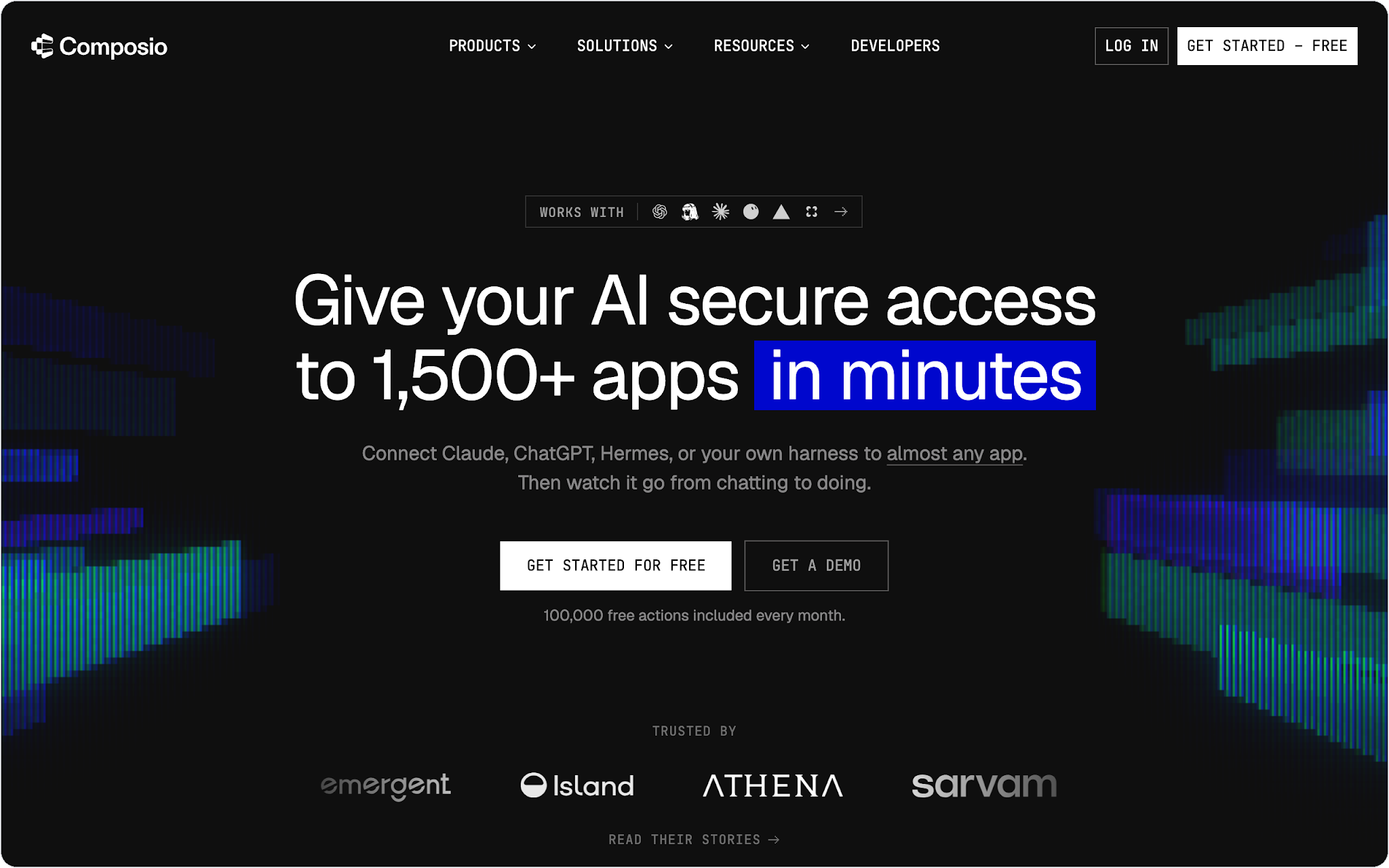
Composio is an integration layer built specifically for AI agents. It ranks first because it pairs one of the broadest agent-native catalogs with managed auth and the largest published free allowance on this list. The site lists 1,500+ apps, including Gmail, Slack, GitHub, Notion, HubSpot and Salesforce, all exposed as tools an agent can call directly or through an MCP server.
Composio handles OAuth, API keys, token refresh and credential lifecycle, so each end user signs in to an app once and the agent acts through that connection. Tokens are encrypted, and the company reports SOC 2 Type II compliance.
Composio is a developer tool first. You get tools and auth, but the product experience around them (where users connect accounts, how you present integrations, how you control costs per customer) is yours to build. Usage is metered per tool call and trigger, so high-volume agents need spend controls from day one.
Pricing: The free Hobby plan includes 100,000 tool calls per month. Pro costs $29/month with usage-based overage. Enterprise is custom.
Best for: Engineering teams building their own agent that need broad app coverage quickly.
2. Albato Embedded
Category: Broad app catalog, embedded and white-label
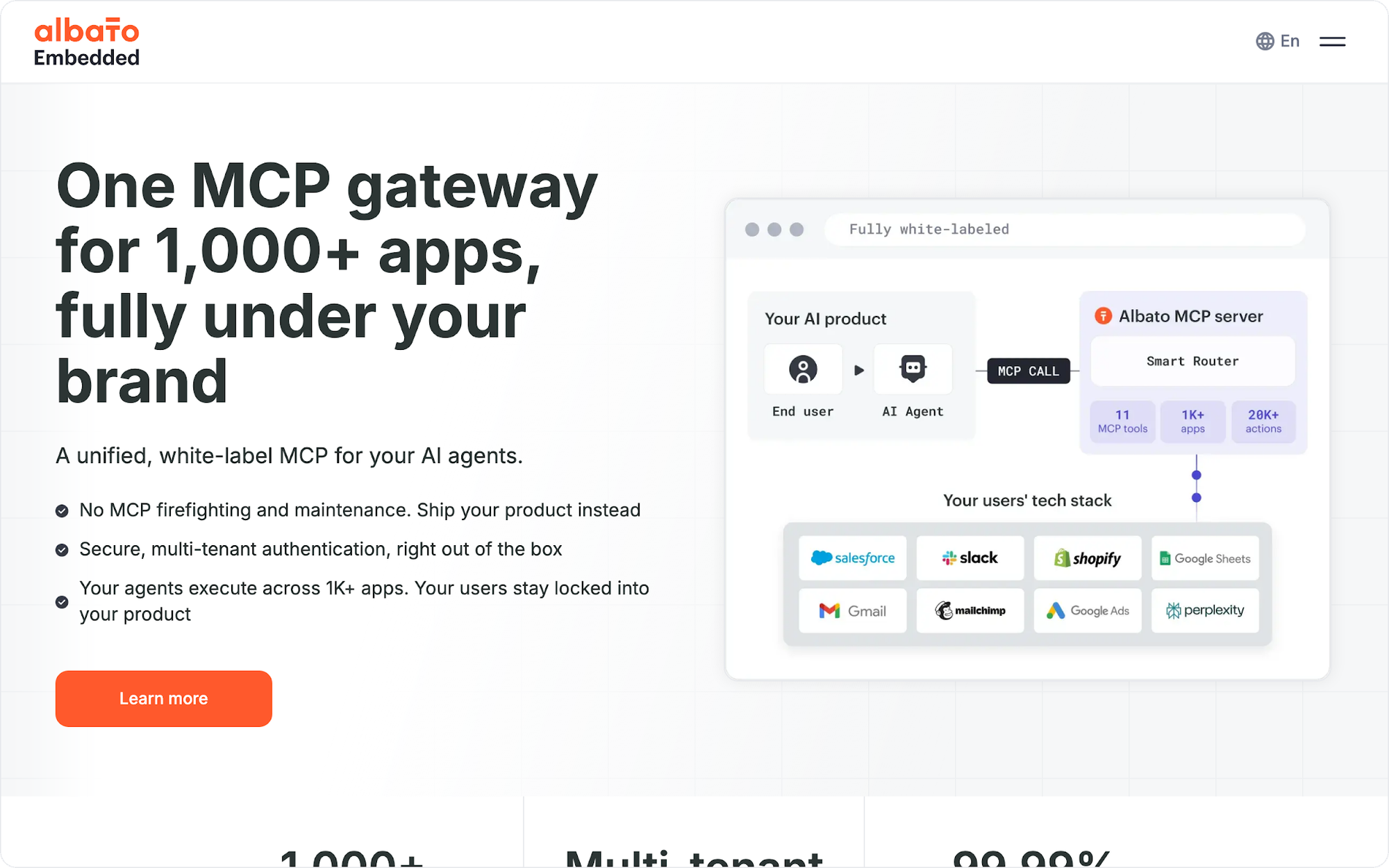
Albato Embedded is a white-label embedded iPaaS: instead of wiring tools into your internal agent, a SaaS company uses it to ship integrations and AI agents inside its own product. It sits at #2 because it covers the case where the agent is part of your product. Your customers connect their own accounts through a white-label flow, and one app library powers both the MCP endpoint and the integration UI and workflow builder you embed.
Its Universal MCP gateway gives an agent one standardized endpoint to actions across 1,000+ apps and 20,000+ triggers and actions. The server is multi-tenant with per-user credential isolation: your agent passes the tenant ID with each call, and Albato routes it to that user's own credentials and permissions. Agents get explicit permissions to call apps or update records, and each action is logged.
Universal MCP, the Headless API and full white-labeling are on the Pro plan, from $5,000/month. The entry Starter plan, from $3,000/month, covers embedded integrations without them, which makes this a higher starting point than the self-serve plans of Composio, Arcade or Merge. Onboarding is sales-led, and most partners go live within 30 to 45 days. Human-in-the-loop approvals are still listed as coming soon.
Pricing: Starter from $3,000/month; Pro, with Universal MCP, from $5,000/month.
Best for: B2B SaaS teams that want their customers to use AI agents inside the product, under the product's brand.
3. Nango
Category: Developer control
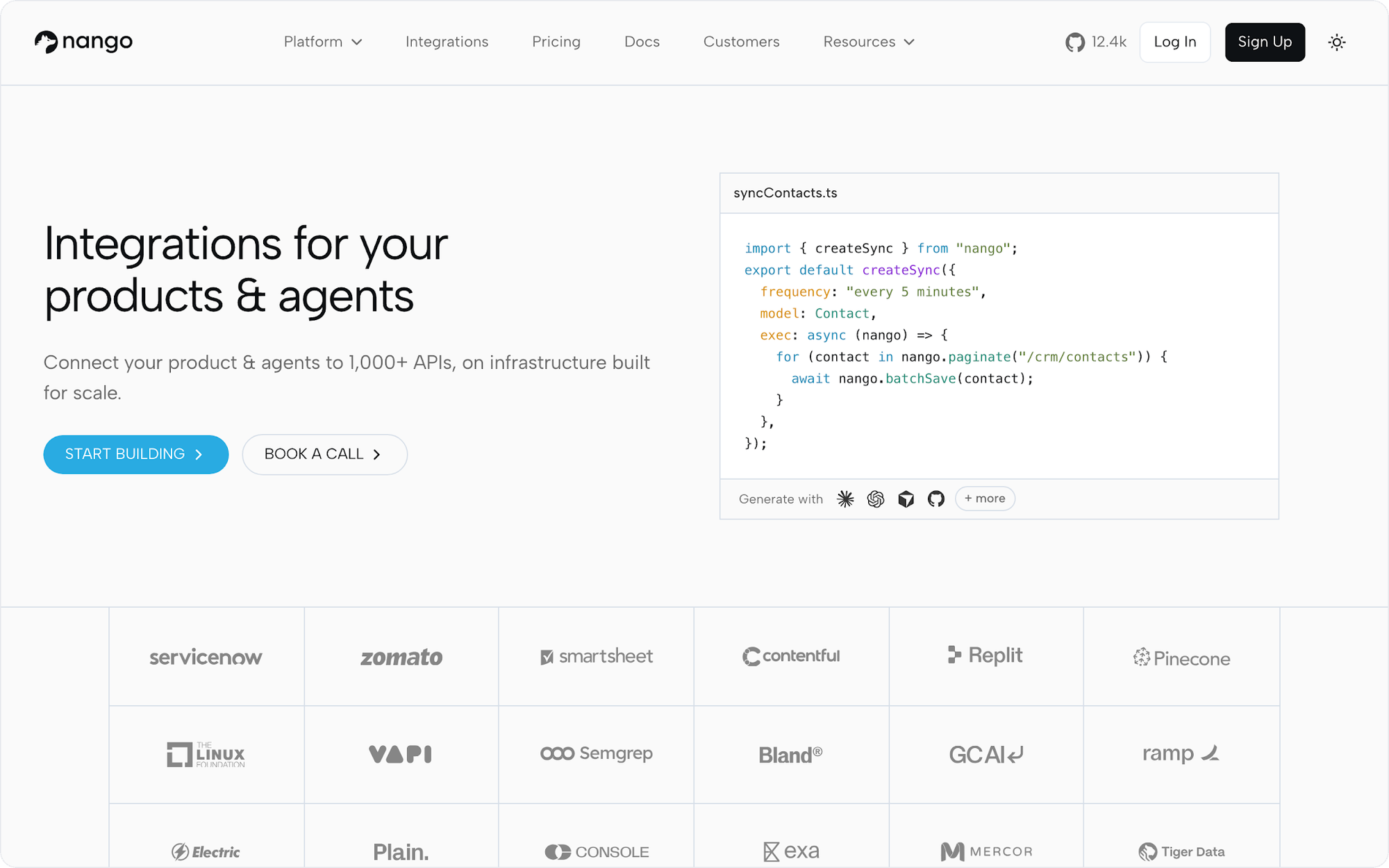
Nango is open-source integration infrastructure for teams that want to own their integration code. It supports 1,000+ APIs and exposes 7,000+ tools through a single MCP server, and it handles OAuth, API keys and token refresh for every API it supports.
The key difference is that integrations are written as code. Actions, syncs, webhooks and triggers are functions you can generate, read, change and deploy, so an agent's tool does exactly what your engineers decided it should do. The repository has more than 12,000 GitHub stars, and Enterprise customers can self-host or bring their own cloud.
That control has a cost. Nango gives you less out of the box than a catalog-first platform, and someone on your team will maintain the functions behind each tool. Teams without engineers who are comfortable with API work will find it slow going.
Pricing: Free plan with hard caps (10 connections, 10 compute hours). Pay-as-you-go starts at $50/month plus usage, for example $0.29 per connection per month. Enterprise is custom.
Best for: Developer teams that want agent tools they can inspect, test and version like the rest of their codebase.
4. Pipedream Connect
Category: Broad app catalog
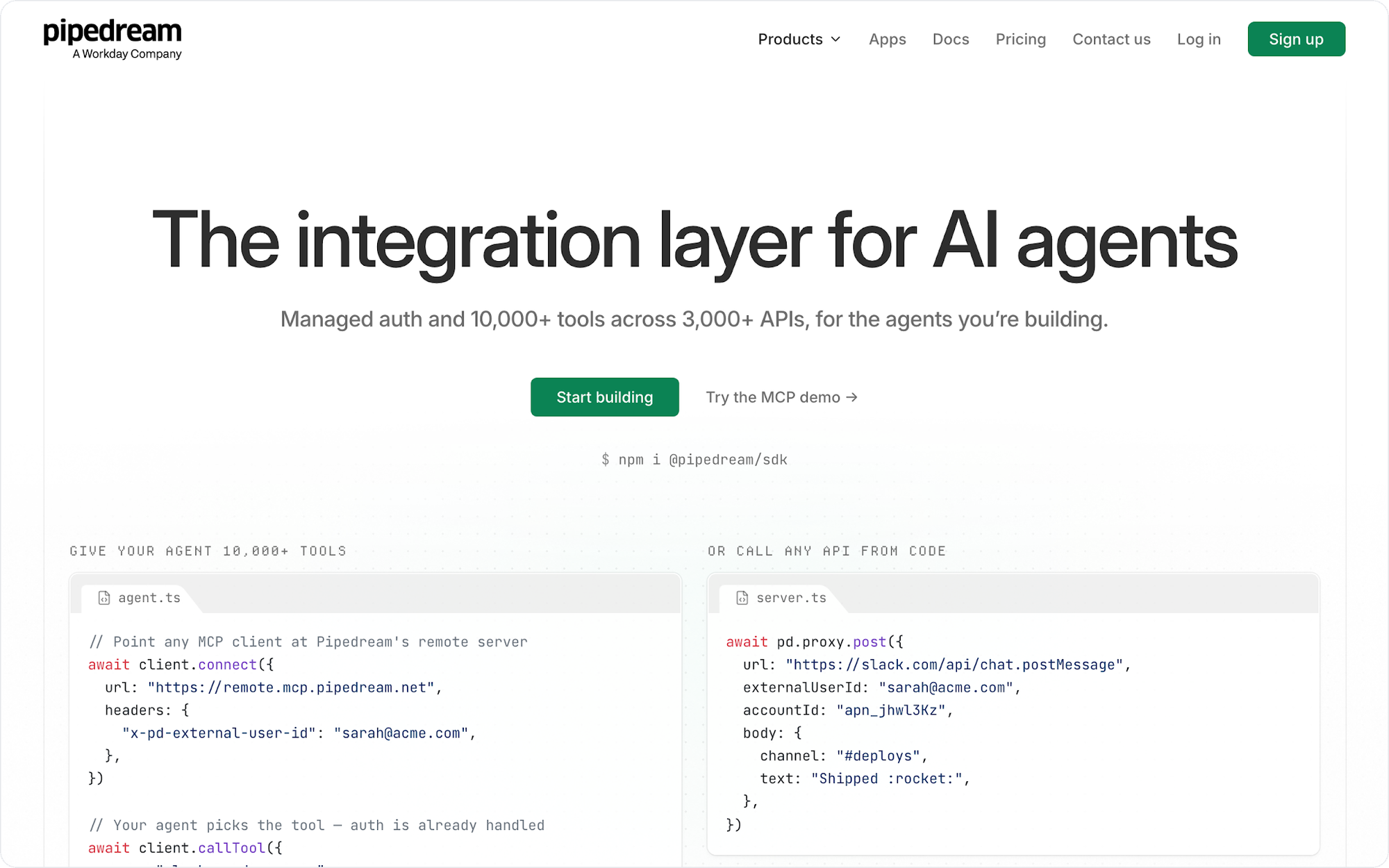
Pipedream Connect is Pipedream's toolkit for adding integrations to your own app or agent. It offers 10,000+ prebuilt tools and triggers across 3,000+ APIs through one remote MCP endpoint, which puts it among the widest catalogs available to an agent today.
Authorization is fully managed. Pipedream runs hosted OAuth clients, stores tokens, refreshes credentials and gives your users a hosted Connect Link flow to authorize their accounts. Each user's credentials are isolated, and they are never exposed to the model or to your client-side code.
The main question mark is direction. Workday announced a deal to buy Pipedream in November 2025 and has since closed it, with the stated aim of connecting AI agents across Workday and third-party systems. Teams outside the Workday ecosystem should watch how the roadmap and pricing evolve. Production pricing for Connect isn't fully spelled out on the Connect page.
Pricing: Free in development mode; production plans are listed on Pipedream's pricing page.
Best for: Developers who want a very large action catalog with managed per-user auth and the option to write custom code.
5. Arcade
Category: Enterprise governance
Arcade calls itself the actions runtime between your agents and the systems they reach, and its focus is authorization. It provides 8,000+ permission-aware tools plus support for custom MCP servers, including Google Workspace, Slack, Microsoft and Salesforce.
The core idea is that an agent acts as its user and never beyond that user's scope. Arcade connects to OAuth providers and identity providers, and one control plane grants, revokes and versions every tool. Each action leaves a record naming the agent, the user and the system, and those records can stream to your SIEM. Enterprise customers can deploy on Arcade Cloud, in their own VPC, or fully air-gapped.
The tradeoff is that Arcade is infrastructure, not an end-user product. You still build the agent and its interface, and usage is metered on both tool calls and auth events.
Pricing: Free with 2,000 tool calls and 2,000 auth events per month. Team costs $25/month plus $0.01 per tool call and $0.10 per auth event. Enterprise is custom.
Best for: Teams where "which user is this agent acting for" is the first security question.
6. Merge Agent Handler
Category: Enterprise governance
Merge is known for unified APIs, and Agent Handler is its product for giving agents governed tool access. It is built on MCP, works with any agent framework, and offers thousands of prebuilt tools.
Merge's features center on control. Tool Packs bundle the exact connectors each agent needs, scoped by agent type, customer tier or environment, so an agent only sees the tools it may call. Users connect accounts through a guided flow with per-user credentials. Full audit logs on all plans record identity, arguments, downstream API calls and outcome, and data loss prevention scanning can block, redact or mask sensitive data in tool inputs and outputs before it reaches a model.
Merge doesn't publish an exact tool count, so check coverage for your own stack before committing.
Pricing: Free plan with 2,000 credits per month. Pro costs $1,000/month with 25,000 credits (expandable to 100,000). Enterprise is custom.
Best for: Companies that need DLP and fine-grained tool scoping before an agent touches customer data.
7. Paragon ActionKit
Category: Developer control, embedded
Paragon is an embedded integration platform for SaaS companies, and ActionKit is its agent-facing layer. It offers one API and MCP server for 1,000+ integration actions across CRMs, ticketing platforms, email and Slack, and works with OpenAI, LangChain and Vercel's AI tooling.
Paragon's advantage is the end-user experience. Embedded UI components give your customers a managed authentication flow inside your product, so they grant an agent access to their CRM or helpdesk without leaving your app.
Paragon is less open on pricing and narrower in scope. It doesn't publish prices, usage scales with the number of connected customer organizations, and ActionKit covers synchronous CRUD actions rather than long-running automation.
Pricing: Custom quote for Pro and Enterprise; free trial available.
Best for: SaaS engineering teams that want embedded, customer-facing agent actions with code-level control.
8. Workato Enterprise MCP
Category: Enterprise governance
Workato is an enterprise automation platform, and its agentic offering includes Enterprise MCP, Agent Studio for building custom agents, and prebuilt agents called Genies for sales, customer experience, IT and security. Enterprise MCP connects clients such as Claude Desktop, ChatGPT, Cursor, or a governed, open-source team workspace like Grengin.
The governance feature that matters most is Verified User Access, where agent actions inherit the authenticated user's identity and role-based access control. Access policies route requests based on user context, and searchable logs track every agent request, response and system event for compliance.
Workato is built for large organizations with dedicated automation teams, and it's a heavy choice for a startup that simply needs an agent to read tickets.
Pricing: Custom.
Best for: Enterprise IT teams that already run Workato and want internal agents to reach business systems under existing identity rules.
9. StackOne
Category: Enterprise governance
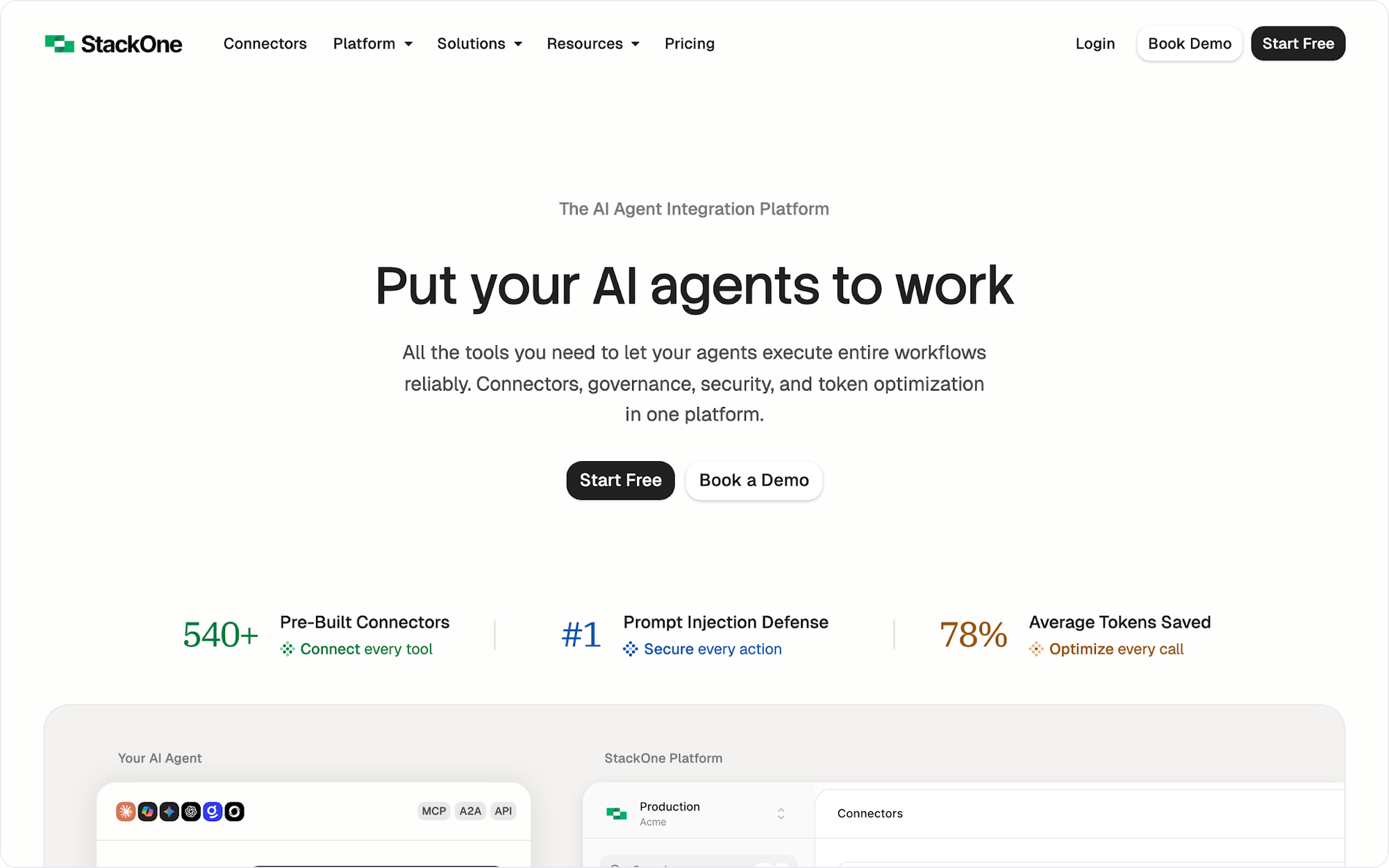
StackOne focuses on enterprise systems such as HRIS, ATS, CRM and IAM tools, with 540+ prebuilt connectors and 33,000+ actions. Every connector is available as an MCP server, alongside A2A, REST APIs and SDKs for Python and TypeScript.
Managed authentication covers OAuth, SAML, API keys and scopes. StackOne's differentiator is security at the tool-response level: its Prompt Injection Guard, according to the company, catches 89% of malicious tool responses before the agent sees them. That matters when an agent reads free-text fields, such as candidate notes or support tickets, that an attacker could have written.
The catalog is narrower than Composio's or Pipedream's, and it leans toward HR and identity systems rather than the long tail of marketing and productivity apps.
Pricing: Free Gateway Starter plan with 1,000 credits per seat each month; Team and Enterprise plans add more features.
Best for: Teams building agents on top of HR, recruiting and identity data, where prompt injection risk is high.
10. Zapier MCP
Category: Broad app catalog
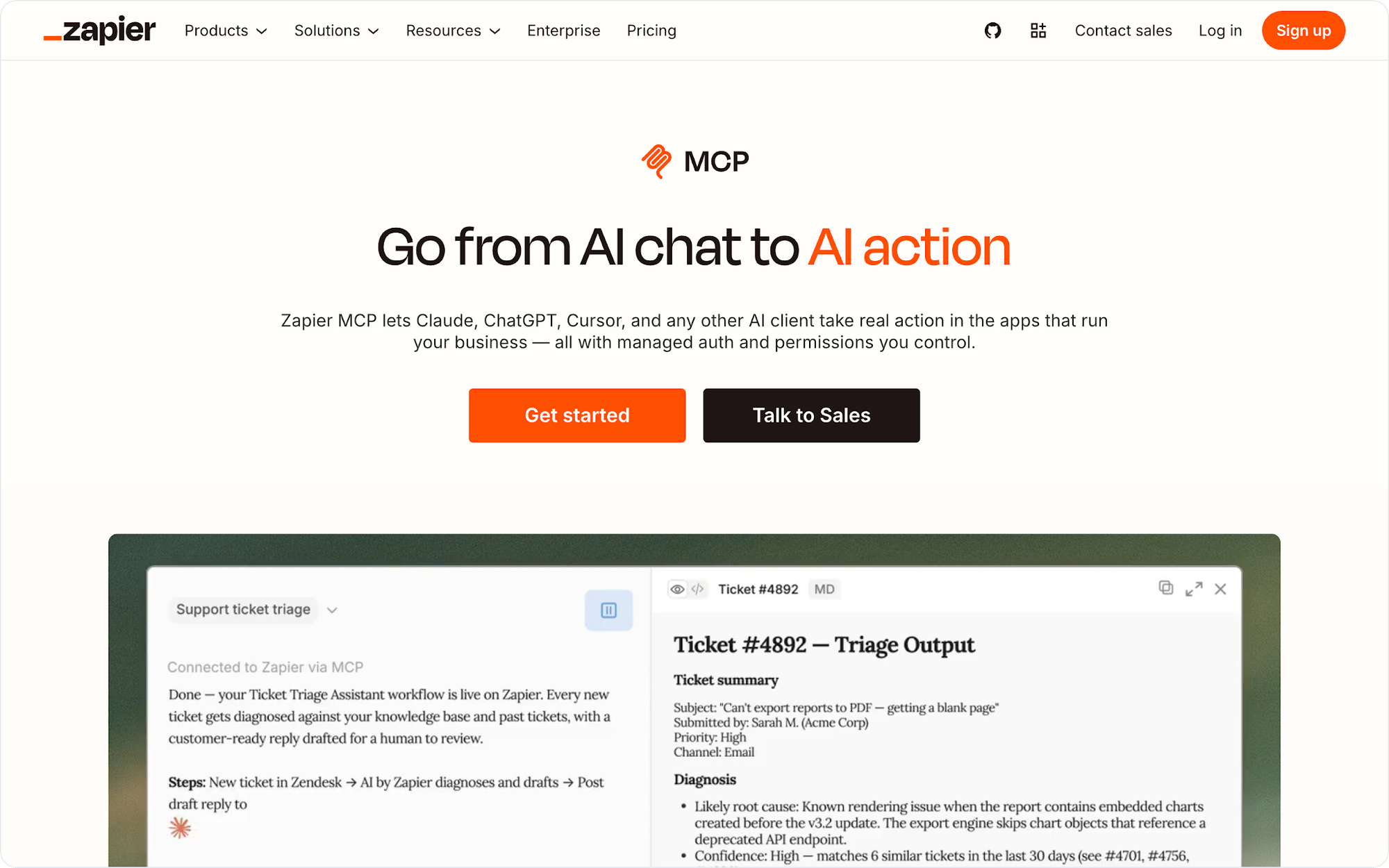
Zapier MCP gives an agent access to 9,000+ apps and 66,000+ triggers and actions through the Model Context Protocol, the largest raw catalog here. App credentials stay in Zapier's managed connection layer rather than being passed to the model.
It ranks last because Zapier MCP is built first for individuals and teams connecting their own accounts to an assistant. Zapier does offer a separate White Label setup for partners that want to connect their end users' accounts, but it is a developer program with no pricing in its docs. And each tool call consumes two tasks from the same quota your Zaps use, which adds up quickly for an agent that makes dozens of calls per conversation. Pair it with a team chat workspace such as Claude, ChatGPT, or Grengin so non-technical staff can use those actions without installing anything locally.
Pricing: Included in every Zapier plan; Professional starts at $19.99/month billed annually.
Best for: Operations and support teams that want their own AI assistant to act in familiar apps with no engineering work.
How to choose
Start with who the agent serves and where it lives. If it's an internal agent your own team uses, Composio, Pipedream Connect or Zapier MCP will get it talking to apps fastest. For internal agents, also decide where your team will actually use them. Integration platforms supply the tools; a chat workspace is where people put them to work. Developers often start with Claude Desktop or Cursor, but for company-wide rollouts a governed workspace such as Grengin lets IT connect MCP servers once, control which teams get which tools, and keep an audit trail of what the AI did.
If it's a feature embedded in the product you sell to customers, look at platforms built around your end users' credentials and your brand. Albato Embedded fits if you want a white-label layer your customers use as is, and Paragon ActionKit fits if your engineers prefer to build the experience themselves.
Next, decide how much control you need over each tool. Nango suits teams that want every action written, reviewed and versioned as code.
Finally, bring in security early. An agent that reads customer-provided or third-party data (support tickets, candidate notes, feedback, logs) is exactly where user-scoped authorization (Arcade, Workato), DLP (Merge) or prompt injection filtering (StackOne) earns its place.
Bottom line
Pick the category first, then test two platforms against one real workflow from your own stack before you commit. For any business process, choose a representative workflow: can the agent execute it as the right user, access the data and systems it needs, and leave an audit log your security team would accept?
Then run the same test from wherever your team will actually use the agent. If that’s a shared workspace like Grengin rather than individual desktop apps, check that its SSO, tool permissions, and audit logs line up with the integration layer’s.