
Decagon has earned its reputation as one of the more capable AI agent platforms for customer service. Its Agent Operating Procedures (AOPs), multi-channel support across chat, email, and voice, and enterprise customer base (Notion, Duolingo, Chime, Rippling) make it a credible choice for large teams looking to automate support conversations.
But the platform is built for a specific profile. It targets enterprise buyers with dedicated engineering resources, six-figure budgets, and the patience for a sales-led, multi-week implementation. For teams that don't fit that profile, or teams that do but are running into specific limitations around process complexity, maintenance burden, or AI controllability, there are real reasons to look elsewhere.
This article covers the best Decagon alternatives for support teams, comparing capabilities, pricing models, and tradeoffs so you can identify which platform fits your operational needs and team structure.
Shortcomings of Decagon
Decagon is a capable product, but several tradeoffs prompt current customers and prospective buyers to explore alternatives:
Prompt-Based Process Execution Hits a Ceiling
Decagon's Agent Operating Procedures (AOPs) use natural language instructions that compile into code. This works for straightforward scenarios, but as processes involve more branching paths, conditional logic, and exception handling, prompts become harder to write, test, and maintain. There's a practical limit to how many if/then conditions a single AOP can handle before the AI starts skipping steps or making errors. Every policy update means re-engineering the prompt and re-testing the workflow.
Maintenance Requires Specialized Resources
Decagon's hands-on implementation model (dedicated Agent Product Managers and Forward-Deployed Engineers) is valuable at setup but creates ongoing dependency. G2 reviewers note that building and tuning AOPs often requires an internal "Agent Engineer" or close vendor collaboration. That creates a separate maintenance track for your AI that runs alongside the processes your human agents already follow.
When your business changes, you need someone to re-engineer the prompt and then test it thoroughly, because changing one part of a prompt can produce unexpected effects elsewhere. Most support operations teams can't handle this on their own.
Enterprise Pricing Without Transparency
No published pricing, no self-serve plan, no free trial, no public documentation. Third-party estimates place annual contracts between $95K and $590K+, with usage-based billing on top of platform fees. For mid-market teams or organizations that want to evaluate before committing, this is a significant barrier.
Agent Assist Limited to Zendesk
Decagon's Agent Assist (AI copilot for human agents) is currently restricted to Zendesk. Teams on Salesforce, Freshdesk, ServiceNow, or other help desks don't get agent-facing AI capabilities.
Generalist Agent Architecture
Decagon deploys a unified AI agent across all issue types. For predictable ticket categories, that works. For diverse support needs (billing, technical troubleshooting, policy, compliance), a single generalist agent may produce weaker responses on specialized topics. Independent reviews also report performance degradation during sudden traffic surges.
With these limitations in mind, here are some alternatives worth evaluating.
Best Decagon Alternatives at a Glance
| Stonly AI Answers | Support teams that need AI built on structured, process-driven knowledge, where the AI follows documented processes step by step rather than interpreting prompts, and your team can update workflows without engineering help |
| Ada | Large support organizations that want high-volume automation across chat, email, voice, and SMS with broad language support and a mature (if opaque) enterprise platform |
| Chatbase | Support teams that want customer-facing AI agents to follow defined processes, take actions in connected systems, and hand complex cases to people |
| Sierra | Enterprise brands that want a fully managed, bespoke AI agent with outcome-based pricing and deep CRM integration, and have the budget and team to support it |
| Intercom Fin | Teams already on Intercom (or considering it) that want a tightly integrated AI agent with transparent per-resolution pricing and no-code setup |
| Zendesk AI Agents | Support teams already on Zendesk that want to add AI automation natively without managing a separate vendor relationship |
Stonly AI Answers
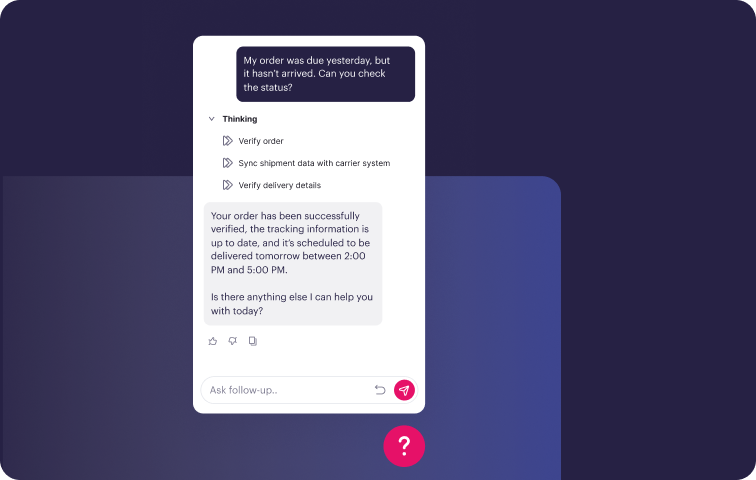
Stonly is a knowledge platform with AI capabilities designed around how customer service teams actually work. Where Decagon and similar platforms start with the AI agent and feed it prompts, Stonly starts with the knowledge. Structured, step-by-step content serves human agents, customers, and AI simultaneously.
Its AI Answers capability uses that structured foundation to handle everything from simple questions to complex multi-step resolutions across chat, email, and WhatsApp, without prompt engineering.
Give AI a Structured Foundation Instead of Prompts
Decagon's AOPs are natural language prompts compiled into code. Stonly's AI Answers works on top of structured, metadata-rich knowledge, like standard articles paired with interactive guides that adapt based on user inputs.
AI Answers also connects to external knowledge sources like Zendesk Guides, Google Docs, and other company content, so teams can leverage existing documentation alongside Stonly's structured content.
A single guide can serve dozens of scenarios by asking targeted questions and routing each person down the correct path. That gives AI the context it needs to handle conditional, multistep situations where generative AI working from unstructured content tends to give generic answers that don't fit the customer's actual situation.
Automate Complex Resolutions With Business Process Agents
Stonly's Business Process Agents (BPAs) follow your documented processes step by step to fully resolve issues. They gather information, make decisions based on conditions, and take actions in backend systems. BPAs follow the same guides your human agents use, so there's no separate "AI documentation" track.
BPAs only take approved, scoped actions and follow each guide step with precision. You can automate more of your support without introducing more risk.
When your return policy changes or you add a new product line, you edit the guide. No prompt re-engineering, no vendor dependency.
Decagon's AOPs become unreliable as branching logic grows, but BPAs have no equivalent ceiling. As long as you can document the process in a Stonly guide, the BPA can follow it accurately. That includes taking actions like updating your CRM, filling in ticket fields, and processing transactions in downstream systems.
Embed AI Directly in Your Support Stack
Stonly integrates with Zendesk, Salesforce, Freshdesk, and ServiceNow. Guides open inside the ticket view, read case fields to pre-fill or skip steps, and write information back.
AI Agent Copilot reads the ticket, surfaces the relevant workflow, drafts a reply, and handles underlying steps when the case allows. In Agent Copilot, reps can review, approve, and step in before actions are taken, giving teams a human-in-the-loop layer for higher-stakes scenarios. This works across all four help desks. Decagon's Agent Assist, by contrast, is currently limited to Zendesk.
You can also deploy the same conversational AI interface for employees in Slack, giving internal teams access to answers and workflows in the tools they already use.
Maintain Accuracy Through Continuous Monitoring
Stonly's AI Knowledge Agents review your ticket stream and source material on an ongoing basis, flagging gaps, contradictions, and stale content for review. Built-in review cycles, version control, and content health scoring round out the system.
Unlike Decagon's model (where maintaining AI behavior means re-engineering AOPs), maintaining Stonly means editing content.
What Stonly AI Answers Offers Over Decagon
- Process execution built on structured guides, not prompts. BPAs follow the same step-by-step processes your human agents use. No AOP prompt engineering, no context window limits, no regression testing when your business changes.
- Your team owns maintenance. Edit the guide when a policy changes. No vendor engineering dependency, no separate "AI documentation" track.
- Agent Copilot across four major help desks. AI Agent Copilot works inside Zendesk, Salesforce, Freshdesk, and ServiceNow. Decagon's Agent Assist is currently limited to Zendesk.
- Proactive knowledge maintenance. AI Knowledge Agents continuously monitor your ticket stream and content for gaps, contradictions, and stale information. Decagon's maintenance model is reactive.
- Structured knowledge makes AI more reliable on hard tickets. When the correct answer depends on account type, product, or geography, AI working from structured guides finds it more often than AI interpreting long prompts.
Things to Consider
- Not a like-for-like AI agent replacement. Stonly's AI Answers is a capability within a knowledge platform, not a standalone autonomous AI agent platform. It's designed to work alongside your support operation rather than replace it entirely. If your primary goal is deploying a fully autonomous conversational AI agent at scale, that's a different product category.
- No voice channel. Stonly also does not currently support voice. AI Answers deploys across chat, email, and WhatsApp, but if AI-powered phone support is a priority, this is a gap.
What Real Customers Are Saying About Stonly
“Our customers love getting instant, interactive help rather than searching through a long text document. It’s a big deal because no one else in our industry has anything like this at the moment. So we’re leading the charge.”
Justin Wilder, Service Coordinator Manager, Anderson America
Tonal saw a 62% lift in workforce adherence, 90% overall QA score, and 7% increase in agent CSAT scores after implementing Stonly.
Pricing
Custom pricing available upon request.
See how AI Answers would handle one of your support processes. Get a demo →
Ada
Ada is an AI-first customer service automation platform that specializes in high-volume deflection across chat, email, voice, and SMS. Its Unified Reasoning Engine powers a single AI brain across all channels, so the agent behaves consistently whether a customer reaches out by phone or by chat.
Ada's Playbooks feature lets the AI execute multi-step service operations (address changes, order modifications, subscription updates) using real-time data. The platform works as an overlay on 13+ help desk and contact center systems, which gives it one of the broadest integration footprints in the category.
What Ada Offers Over Decagon
- Broader channel maturity out of the box, including native voice and SMS support that has been in market longer than Decagon's.
- More established install base (550+ AI agents deployed vs. Decagon's younger customer roster), which can provide more confidence for risk-averse buyers.
- Works as an overlay on 13+ help desk and contact center platforms (Zendesk, Salesforce, Freshworks, Genesys, Gladly, Gorgias, Help Scout, Kustomer, NICE CXone, and others), giving it broader help desk compatibility than Decagon's Agent Assist.
Things to Consider with Ada
- Pricing is opaque and conversation-based. Ada charges per conversation (not per resolution), meaning you pay even when the AI fails to resolve the issue. Third-party estimates place annual costs starting around $30K, scaling significantly with volume.
- Process execution still relies on prompts and configurations. Ada's Playbooks are more structured than raw prompts, but complex multi-step processes with branching logic still require careful setup and close collaboration with Ada's team. Updating processes as your business changes can be time-consuming.
- Knowledge ingestion has gaps. Ada cannot natively ingest PDFs, past ticket conversations, or content from tools like Notion, which limits the breadth of knowledge the AI can draw from without workarounds.
- Enterprise-only positioning. The sales process is quote-based with annual commitments, and enterprise deployments typically take 8-16 weeks.
Pricing
Custom, quote-based pricing. Conversation-based billing model. No published rates.
Chatbase
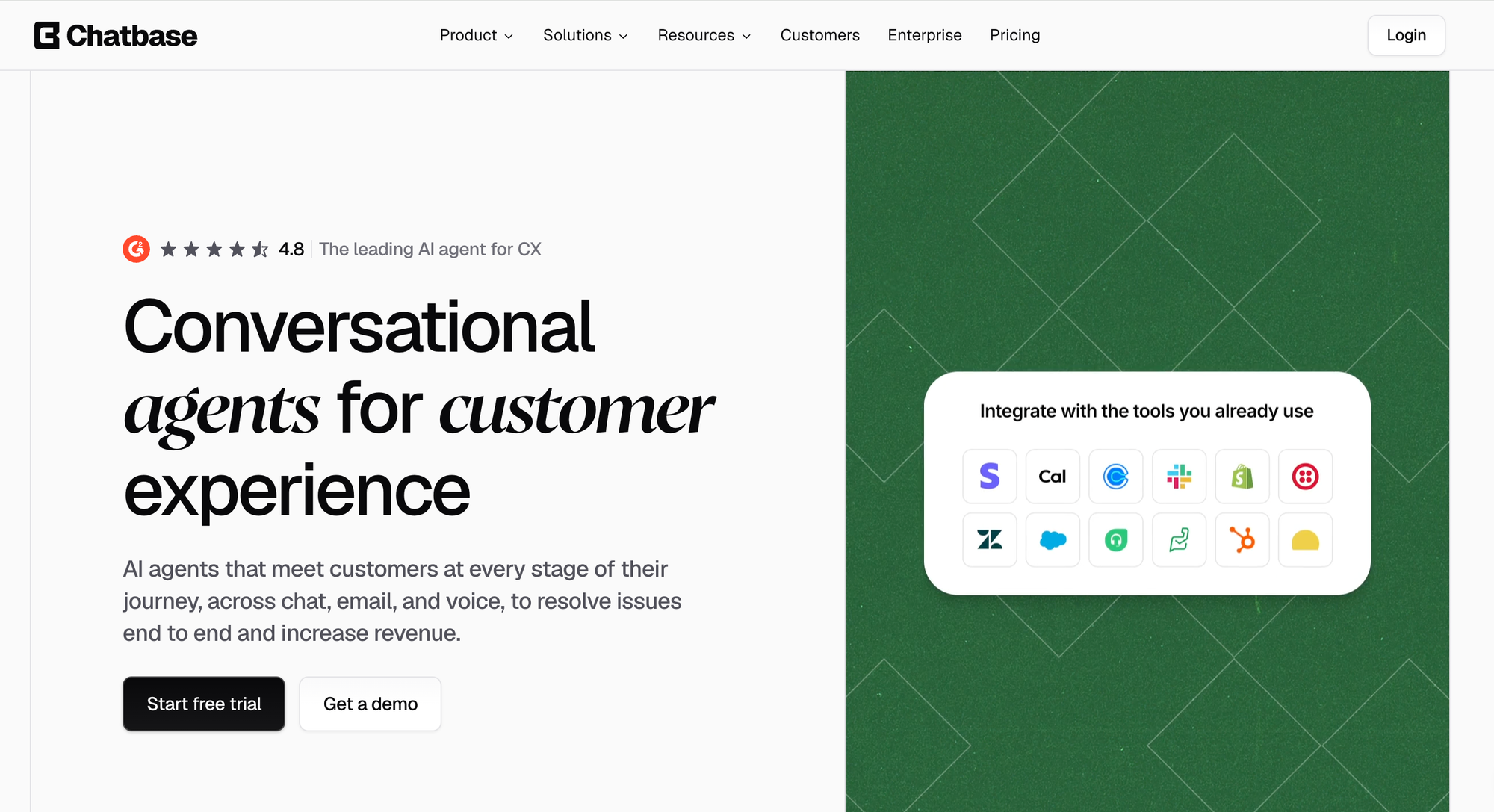
Chatbase is an AI customer service platform for teams that want agents to handle customer requests across chat, email, messaging, and voice. Agents use company content to answer questions and Actions to retrieve information or complete tasks in connected systems. Teams can manage escalations in Chatbase’s built-in Helpdesk or connect an existing support tool.
Procedures let support teams define the steps behind a request in plain English, including required checks, conditions, lookups, Actions, and approval points. For a Shopify return, an agent can identify the order, check the store’s return window, and complete an eligible return using a configured Action. Teams can restrict sensitive Actions to specific Procedures and test saved scenarios after changing a policy.
Chatbase also supports interactive Widgets. An agent can show a product card, form, or order details within the conversation when a visual interface helps the customer complete a task.
What Chatbase Offers Over Decagon
- Published plan pricing: Chatbase lists monthly prices and message-credit allowances, including a free plan, so teams can evaluate an entry point before discussing enterprise pricing.
- A built-in Helpdesk: Teams can assign and take over escalated conversations in Chatbase while keeping AI and human support in one workflow. Supported integrations also let teams work with an existing helpdesk.
- Procedures with visible steps and testing: Teams can set required checks and approval points, inspect which steps ran, and rerun saved scenarios after a change.
- Interactive Widgets: Agents can present product cards, forms, and order information within a conversation.
- Native Shopify Actions: Agents can help with product discovery, order lookup, eligible returns and refunds, exchanges, and replacement orders. New exchange orders require human approval in Chatbase’s Helpdesk.
Things to Consider
- Teams need to connect their data and business systems, configure Actions and Procedures around their policies, and test sensitive workflows before deployment.
- The free plan includes 50 message credits per month. Helpdesk, voice, and API access start on the Standard plan.
Pricing
Chatbase publishes monthly plans: Free with 50 message credits, Hobby at $40/month with 700 credits, Standard at $150/month with 4,000 credits, and Pro at $500/month with 15,000 credits. Enterprise pricing is custom. Plans include monthly message credits rather than a stated per-resolution fee.
Sierra
Sierra is a standalone AI agent platform that positions itself as an "Agent Operating System" rather than a help desk add-on. Its agents take real actions (processing returns, updating subscriptions, verifying identity) and deploy across chat, voice, SMS, WhatsApp, and email.
The platform combines generative AI for natural conversation with deterministic logic for business rules, which reduces hallucination risk on sensitive operations. Sierra operates as a fully managed service: the vendor builds, deploys, and optimizes the agent for you. The company targets large enterprises, citing that roughly 40% of the Fortune 50 are customers.
What Sierra Offers Over Decagon
- Outcome-based pricing where you pay per successful resolution, not per conversation, which can be more cost-efficient for teams with lower resolution rates.
- Deeper voice capabilities following continued investment in its voice platform.
- Larger enterprise footprint with more published case studies that include specific metrics.
Things to Consider
- Even more expensive than Decagon. Third-party estimates place year-one costs at $200K-$350K+, and larger deployments can reach much higher.
- Managed service model means less team autonomy. The vendor builds and operates the agent for you. That's a feature for teams that want a hands-off approach, but a limitation for teams that want to own and iterate on their AI workflows internally.
- Not built for mid-market. There's no self-serve option, no trial, and the platform is designed for organizations with dedicated CX improvement budgets.
- Still maturing on legacy system connectivity. Sierra's integrations with older contact center infrastructure and live-agent escalation pathways are less developed compared to incumbent vendors in the space.
Pricing
Custom, quote-based pricing. Outcome-based billing (per successful resolution) plus platform subscription. No published rates.
Intercom Fin
Fin is an AI agent that can run inside Intercom's platform or deploy standalone on other help desks (Zendesk, Salesforce, etc.). It specializes in content-driven resolution. The AI reads your help center articles, knowledge base, and connected sources, then answers customer questions across chat, email, and voice in 45+ languages.
Its clearest differentiator is transparent, published pricing ($0.99/outcome), which is rare in a category dominated by opaque enterprise quotes.
Buyers evaluating long-term vendor commitments should note that Salesforce signed a definitive agreement to acquire Intercom for approximately $3.6B in June 2026. The deal is expected to close around Q4 of Salesforce's FY2027.
Post-acquisition, Fin's technology is expected to fold into Salesforce's Agentforce platform, which introduces meaningful uncertainty around pricing, product direction, and platform independence.
What Fin Offers Over Decagon
- Published, transparent pricing at $0.99 per outcome (you aren't charged when Fin escalates without producing a billable outcome), which makes cost modeling significantly easier than Decagon's opaque enterprise quotes.
- No-code configuration accessible to CX teams without engineering resources, lowering the barrier to setup and ongoing maintenance.
- Can run as a standalone AI agent on external help desks (Zendesk, Salesforce, etc.), not just within Intercom.
Things to Consider
- Costs can scale unpredictably. At $0.99 per outcome with no volume caps, a team resolving 10,000 conversations per month pays roughly $10K/month in AI fees alone, on top of Intercom seat costs ($29-$139/seat/month).
- Pending Salesforce acquisition creates uncertainty. Post-acquisition, Fin's technology is expected to fold into Salesforce's Agentforce platform. For teams evaluating long-term vendor commitments, this introduces questions around pricing, product direction, and platform independence.
- Process automation is more limited. Fin excels at answering questions from your content, but for complex, multi-step processes with branching logic and backend actions, its capabilities are less mature than Decagon's AOPs or platforms built specifically for process automation.
- Strongest when paired with Intercom's help desk. Standalone deployments lack deeper capabilities like workflow automation and reporting.
Pricing
$0.99 per outcome. Intercom seat plans range from $29/seat/month (Essential) to $139/seat/month (Expert). Minimum of 50 outcomes/month ($49.50) when running standalone.
Zendesk AI Agents
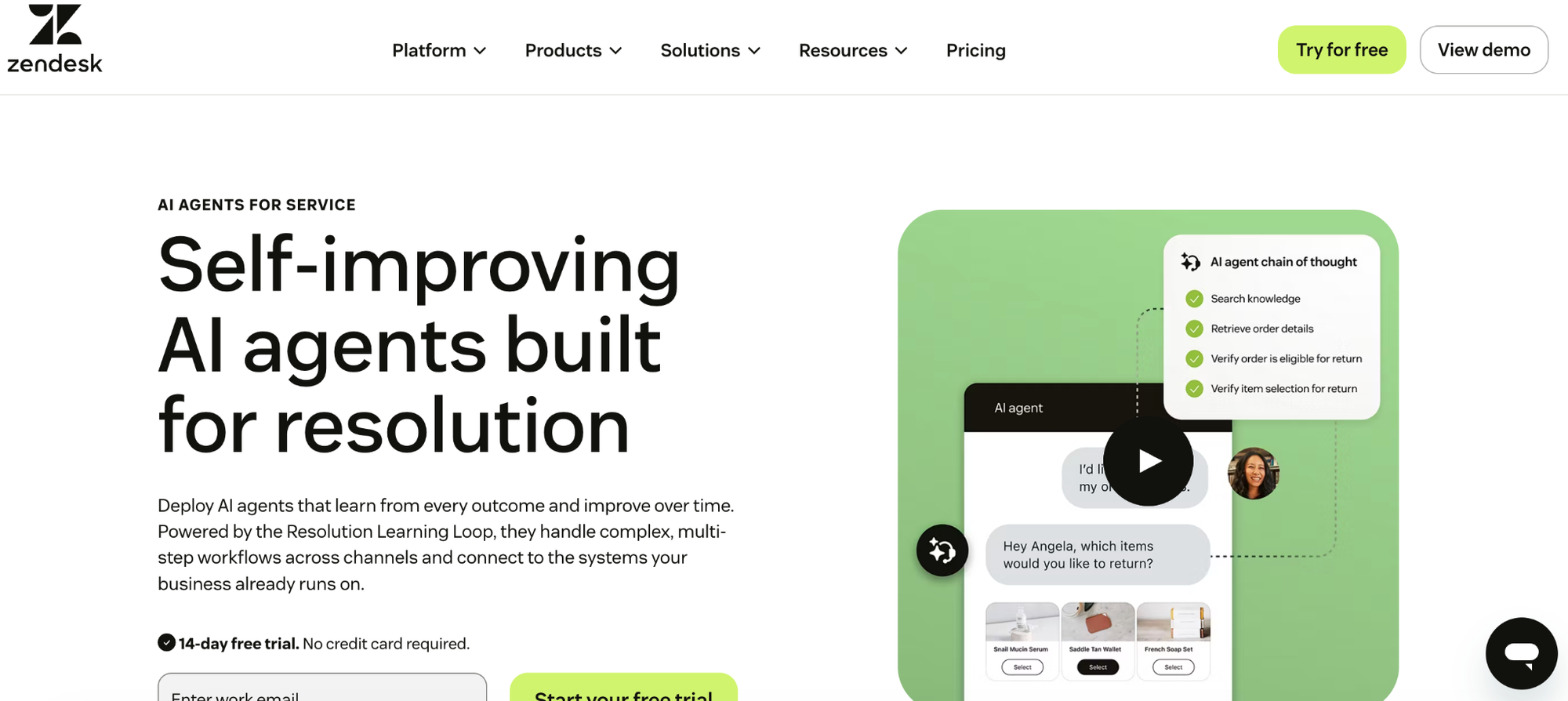
Zendesk AI Agents are the native AI automation layer built into Zendesk's support platform. The core value proposition is zero friction for existing Zendesk teams. There’s no separate vendor, no additional integration, and the AI draws directly from your Zendesk Guide content.
Agent Builder gives CX teams a no-code tool to create custom AI workflows, and the AI supports messaging, email, and voice in 80+ languages.
What Zendesk AI Offers Over Decagon
- Zero additional integration work for existing Zendesk teams. The AI is native to the platform and pulls directly from your help center content.
- No-code Agent Builder lets CX teams create and deploy custom AI workflows without engineering support.
- Lower starting price point for teams that already pay for Zendesk seats, though AI costs are layered on top.
Things to Consider
- Costs stack up in layers. Zendesk Suite runs $55-$115/agent/month, the Copilot add-on is roughly $50/agent/month, and AI resolutions bill at $1.50-$2.00 each. A 20-agent team resolving 3,000 AI conversations per month can realistically spend $80K+/year all-in.
- Platform lock-in. Zendesk AI Agents only work within Zendesk. If you migrate help desks, the AI layer doesn't come with you.
- AI is only as good as your existing content. Zendesk AI draws from your Guide articles. If that content is outdated, unstructured, or incomplete, the AI's resolution quality will reflect it. There's no built-in mechanism to proactively identify knowledge gaps or flag stale content.
- Automatic overage billing. Zendesk introduced auto-billing for AI resolution overages in January 2026, with limited advance notice, which has caught some teams off guard during volume spikes.
Pricing
Zendesk Suite: $55-$115/agent/month. Copilot add-on: ~$50/agent/month. AI Agent resolutions: ~$1.50-$2.00 per resolution (usage-based).
Consider a Knowledge-First Approach to AI-Powered Customer Service
Decagon, Ada, Sierra, Fin, and Zendesk are all AI-agent-first tools. They sit on top of your existing content and try to resolve issues autonomously using prompts, playbooks, or compiled instructions. Maintaining those prompts requires specialized skills and ongoing vendor collaboration, and when processes change, you're re-engineering prompts and testing for regressions.
Stonly's AI Answers builds on structured knowledge and documented processes that your team already maintains for human agents. When something changes, you update the guide, and the AI follows the updated process immediately.
Two questions matter for support teams evaluating AI for customer-facing resolution. Which platform resolves the most issues, and how will your team build and maintain the processes behind it?
Learn more about how Stonly's AI Answers would handle your support processes.