

At most banks and credit unions, the most reliable knowledge base is a person. It’s the teller who has been at the branch for 20 years, the operations manager who knows which form goes with which exception, or the contact center lead who remembers how the last fee change was supposed to be explained. Everyone else relies on a mix of shared drives, binders, intranet pages, and old emails.
That arrangement breaks down when experienced staff retire, new hires need to be productive in weeks instead of months, a core conversion replaces the screens everyone memorized, or examiners ask for proof that procedures were followed. Meanwhile, customers and members expect the same answer whether they call, visit a branch, or use the mobile app, and AI tools repeat whatever errors sit in the content they draw from.
A knowledge base built for banking has to capture what those experienced employees know, keep it current through constant regulatory and product changes, and deliver it wherever reps and customers need it. This guide covers what banks and credit unions need from their knowledge, then looks at five tools and the use case each one fits best.
What Banks and Credit Unions Need From a Knowledge Base
Banks and credit unions manage knowledge for customers and members, for the reps who serve them across branches and contact centers, and for internal teams like compliance and operations.
- Answers that vary by product, account type, and customer: Fees, holds, and procedures differ across checking, savings, cards, loans, and business accounts. Look for knowledge that can be filtered or personalized so each rep sees the version that matches the account in front of them.
- Regulated processes handled the same way every time: Account opening, disputes, fraud reports, and hardship requests have required steps and sometimes strict timelines. Reps need guidance through each step, and leaders need evidence it was followed when examiners ask.
- Content that stays current and audit-ready: Rates, fees, product terms, and regulations change constantly. Look for approval workflows, version history, review reminders, and a fast way to find every procedure affected by a change.
- One answer across branches and the contact center: Branch staff often cover many products without a specialist nearby. Customers and members expect the same answer wherever they ask, so every channel needs to work from the same approved content.
- Knowledge inside the systems reps already use: Reps already move between a core banking system, a CRM, and a contact center desktop. Knowledge should appear inside those tools instead of adding another tab.
- Digital self-service and AI limited to approved answers: Customers and members want help in online and mobile banking without calling. AI can handle much of that volume, but it should answer only from approved content and hand off to a rep when it can’t answer with confidence.
- A governed home for internal policies: Board-approved policies, compliance procedures, and operational manuals often sit in shared drives that were never designed for governance. They need version control, approvals, and records of who has read what.
Very few tools cover all of this well, and most banks and credit unions end up with more than one. The tools below are grouped by what each does best.
The Best Knowledge Base Software for Banks and Credit Unions at a Glance
- Stonly: Best for bank and credit union service teams that want faster, more consistent reps and more customer self-service
- eGain: Best for institutions that want an established enterprise KM vendor with a banking-specific suite
- KMS Lighthouse: Best for institutions focused on contact center knowledge
- ScreenSteps: Best for credit unions and community banks documenting procedures for branch and back-office staff
- Bloomfire: Best for governing internal policies and procedures
Stonly
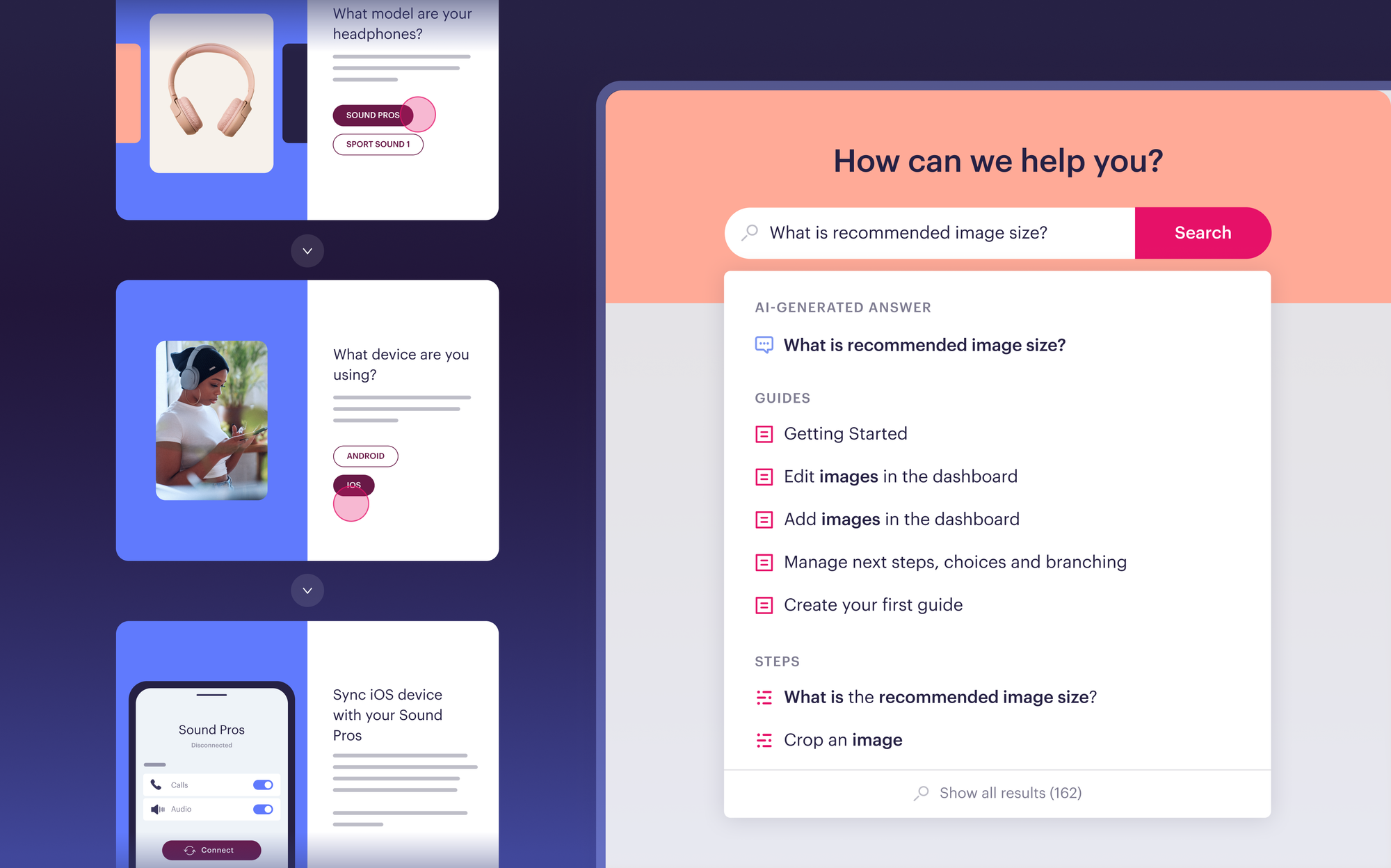
Best for: Bank and credit union customer service teams that want to speed up their reps and help more customers and members self-serve with personalized knowledge, AI that answers from approved content, and process automation.
Stonly is a knowledge management platform built for customer service. One platform serves reps in branches and contact centers, customers and members, and AI, so when a fee, rate, or regulation changes, a single update reaches every channel at the same time.
Personalized Knowledge by Product, Account Type, and Customer
You can personalize individual pieces of content or the entire knowledge base using your customer and employee data. A rep helping a business customer with a wire transfer and a teller helping a consumer with a debit card can search the same knowledge base and see only the guidance that applies.
The same applies to customers and members. Someone with a personal checking account doesn’t need to read through business banking content to find their answer. For institutions offering many products across branches and channels, this keeps one knowledge base usable instead of splitting it into separate versions for each team.
AI Answers and AI Agent Copilot
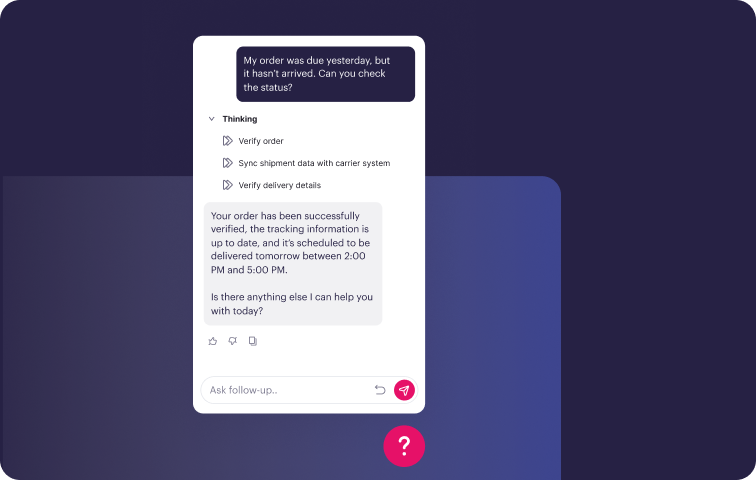
AI Answers gives customers and members conversational self-service in search or as a standalone chat, and gives reps a way to ask questions in plain language instead of putting someone on hold to ask a supervisor.
Several things make it a fit for banking:
- Approved content only: AI Answers pulls only from the knowledge you’ve published, so it answers from your policies and procedures instead of improvising.
- Context-aware answers: Answers take the rep’s or customer’s current context into account, so the response matches the product, account, or situation involved.
- Clarifying questions: When more than one answer could apply, such as a fee question that depends on account type, AI Answers asks a follow-up question instead of guessing.
- Handoff to people: When AI can’t resolve the question, it hands off to a rep.
- Analytics on AI performance: Your team can see which questions AI answers well and where content is missing.
AI Agent Copilot works alongside reps inside the ticketing system or CRM. It suggests relevant guidance based on the case and can trigger actions in connected systems.
Both rely on Stonly’s structured knowledge. Because each step in a guide holds specific information tied to a specific condition, AI can find the correct answer more reliably on “it depends” questions. Most fee, hold, and dispute questions fall into that category. The same applies if you bring your own AI and feed it Stonly knowledge.
Guidance Inside the CRM and Ticketing System
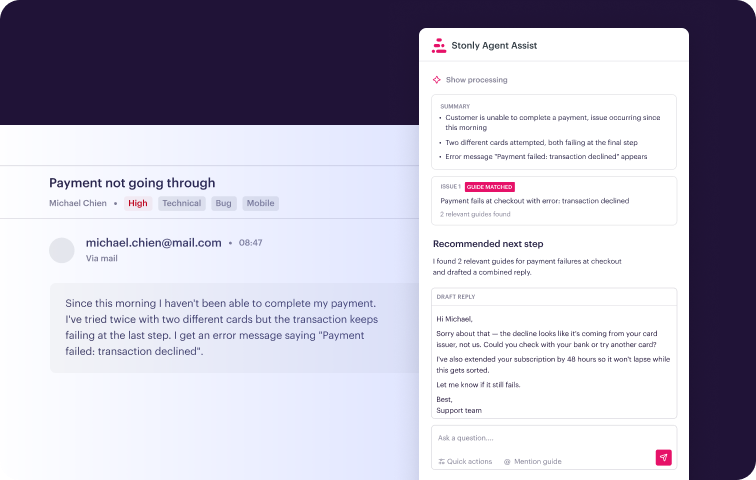
Stonly integrates with Salesforce, Zendesk, Freshworks, ServiceNow, and more. Relevant guidance appears in the case view based on case context, so reps don’t open another tab to search. They also get one-click access to knowledge in the other web-based tools they use.
Knowledge Agents That Keep Content Current
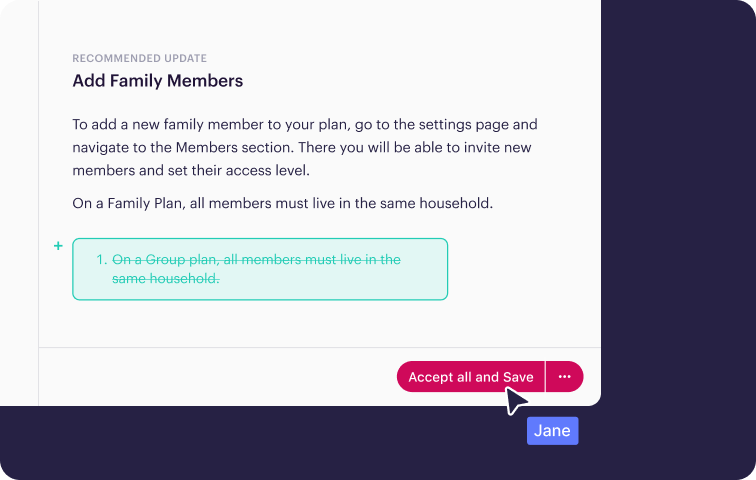
Knowledge Agents keep procedures accurate through rate changes, fee updates, new regulations, and system conversions. They connect to the places where questions and changes come from, including incoming cases, search results, AI conversations, and policy changes. They scan your knowledge continuously for duplicates, mistakes, outdated content, and topics that have no content yet.
When something needs attention, they outline what’s required and draft an update that follows your institution’s guidelines. Your team reviews and publishes it, so nothing goes live without human approval.
Your team can also ask Knowledge Agents for help directly. Examples for banks and credit unions:
- Convert a PDF policy into a step-by-step procedure reps can follow
- Update every article that references a changed fee or rate
- Add a new disclosure to every article in a product category
- Show every procedure that references screens from a system you’re replacing
- Find content that hasn’t been reviewed in the last six months
Procedure Adherence and Analytics by Rep
Stonly tracks how reps use knowledge and follow procedures, with analytics by content, by step, and by person. Leaders can see which procedures reps follow, where they drop off, and which content gets used or skipped.
For compliance teams, that turns “we trained them on it” into evidence that required steps were followed. For knowledge teams, it shows exactly where content needs work.
Business Process Automation
Stonly guides can take actions on behalf of reps and customers. A guide can fill in case fields, update records, or run a macro as the rep moves through it. Each case takes fewer manual steps, and the process stays consistent across branches and teams.
Step-by-Step Guides for Disputes, Account Opening, and Fraud
Stonly is the only full-featured knowledge base that offers both standard articles and step-by-step guides. A guide breaks a process into steps, asks what the rep is working with, and shows only the path that applies.
With guides, a new rep handling a card dispute follows the same sequence an experienced rep would, with the required questions, documentation, and disclosures at each step.
Self-Service in Online and Mobile Banking
Stonly’s Widget puts your knowledge inside online banking, mobile apps, and your website. No-code triggers let you show a specific guide at a specific moment through banners and tooltips. Customers and members can get help resetting access, setting up transfers, or understanding a fee without leaving the page they’re on.
Security and Compliance
Stonly holds SOC 2 Type II certification, is GDPR compliant, and carries cyber-risk insurance.
How Banks and Credit Unions Use Stonly Across Teams
- Contact center: Personalized answers and procedures for account, card, and online banking questions
- Branches: Shared approved content so tellers and bankers give the same answers as the contact center
- Operations: Step-by-step procedures for back-office processes, with clear ownership by department
- Lending: Guidance on loan products, required documentation, and disclosures
- Training: Faster ramp for new hires through guidance in the flow of work instead of memorization
A Team Behind the Platform
Customers work with product managers and CSMs who have helped more than 1,000 companies get results from their knowledge.
What Financial Institutions Are Saying About Stonly
“We’ve seamlessly integrated Stonly into our organization. As a result, we can empower employees with the knowledge they need to be more efficient and accountable.”- Jordan McMahon, Executive Administrator, Glenwood State Bank
“With Stonly as our always up-to-date source of truth, client-facing teams can respond twice as fast and more accurately.”- Thomas Thieffry, Head of Product, Bpifrance
Pricing
Stonly offers custom pricing for small businesses and enterprise companies.
Request a demo to see how Stonly works for bank and credit union service teams.
eGain
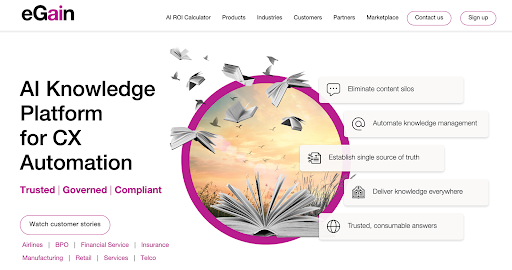
Best for: Banks and credit unions that want an established enterprise knowledge management vendor with a banking-specific suite.
eGain is a long-established knowledge management vendor with a strong presence in banking. It recently launched the AI Knowledge Suite for Retail Banking, aimed at community banks, regional banks, and credit unions. The suite combines eGain’s AI Knowledge Hub with banking-specific capabilities for guided sales conversations and regulatory compliance.
Key Features for Banks and Credit Unions
- Governed knowledge hub: A central knowledge repository intended to deliver consistent answers across branches, contact centers, self-service portals, and AI assistants.
- Guided sales conversations: eGain Sales Advisor walks frontline staff through needs-based questions and recommends products that fit the customer.
- Compliance capabilities: The banking suite includes AI-powered regulatory compliance through a partnership with AscentAI.
- Contact center desktop integration: Knowledge can be delivered inside contact center platforms such as Genesys.
Things to Consider
- Enterprise implementation effort: Deployments typically require substantial setup, content modeling, and a dedicated knowledge team.
- Many separate products: Capabilities are spread across several eGain products and partner integrations, so scoping what you need can take extra work.
- Partner dependencies: Parts of the banking suite rely on third-party partners, so you’ll have more vendors in your review and contract process.
Pricing
eGain lists prices of $25 per user per month for AI Knowledge Hub and $0.50 per resolution (or $25 per user per month) for its AI Agent. It also offers a free trial and a no-cost 30-day pilot. Enterprise deployments are typically quoted.
KMS Lighthouse
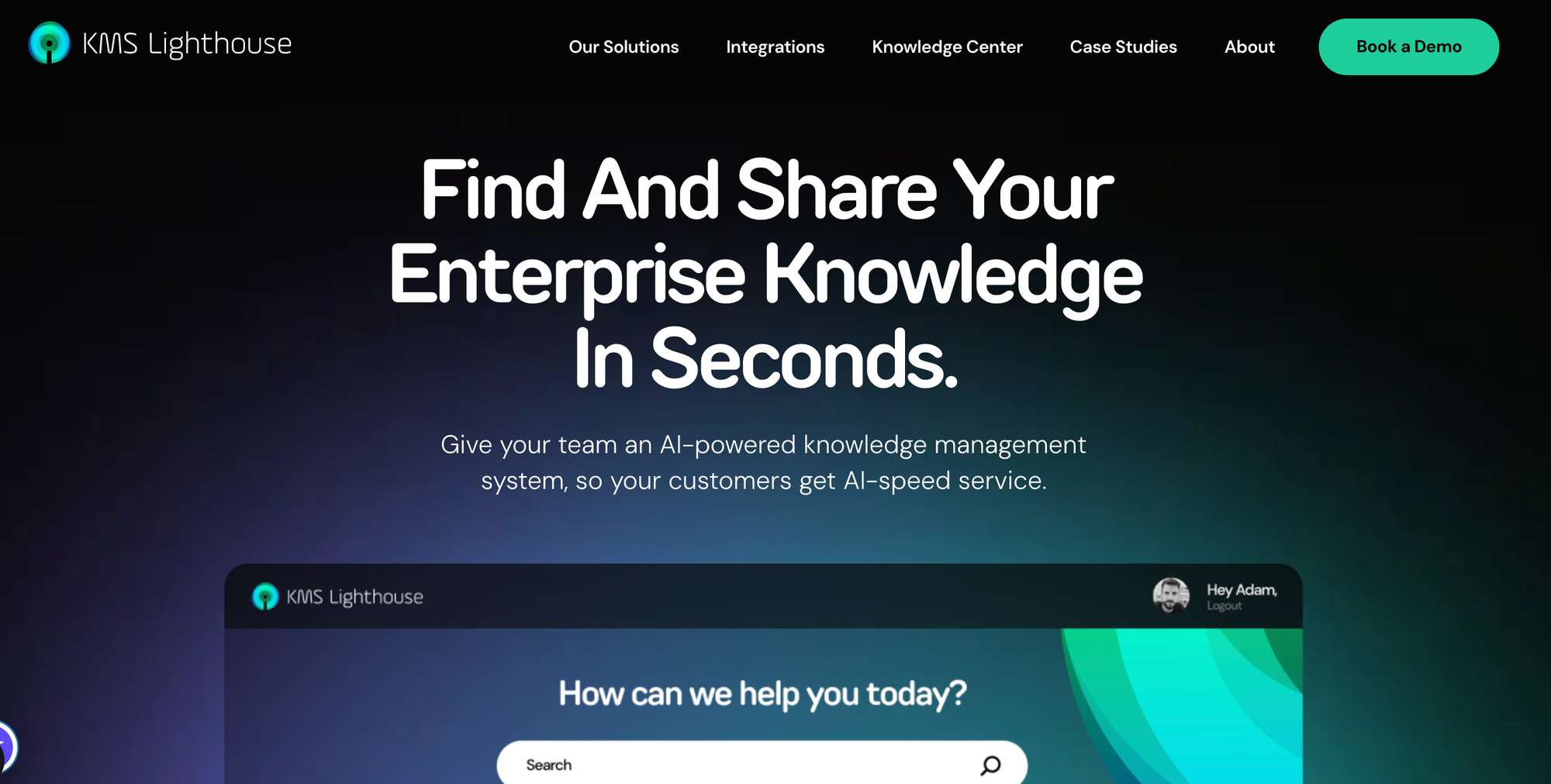
Best for: Institutions focused on contact center knowledge.
KMS Lighthouse is a knowledge management platform designed for contact centers, built to get reps to answers quickly during live interactions. It serves midsize and large organizations, including those in regulated industries.
Key Features for Banks and Credit Unions
- Answer trees: Guided answer trees walk reps through processes, and users often highlight them in reviews.
- Internal and external knowledge: Content can be reused across assisted service and customer self-service.
- CRM integration: Offers a native Salesforce integration so reps can access knowledge inside the CRM.
Things to Consider
- Governance effort: Like most contact center knowledge platforms, it requires taxonomy design and ongoing ownership to keep content accurate.
- Embedding may need configuration: Some environments need additional setup or services to place knowledge in rep desktops.
- Less suited to branches and back office: Its contact center focus may leave branch and operations teams needing a different approach.
Pricing
KMS Lighthouse provides pricing on request.
ScreenSteps
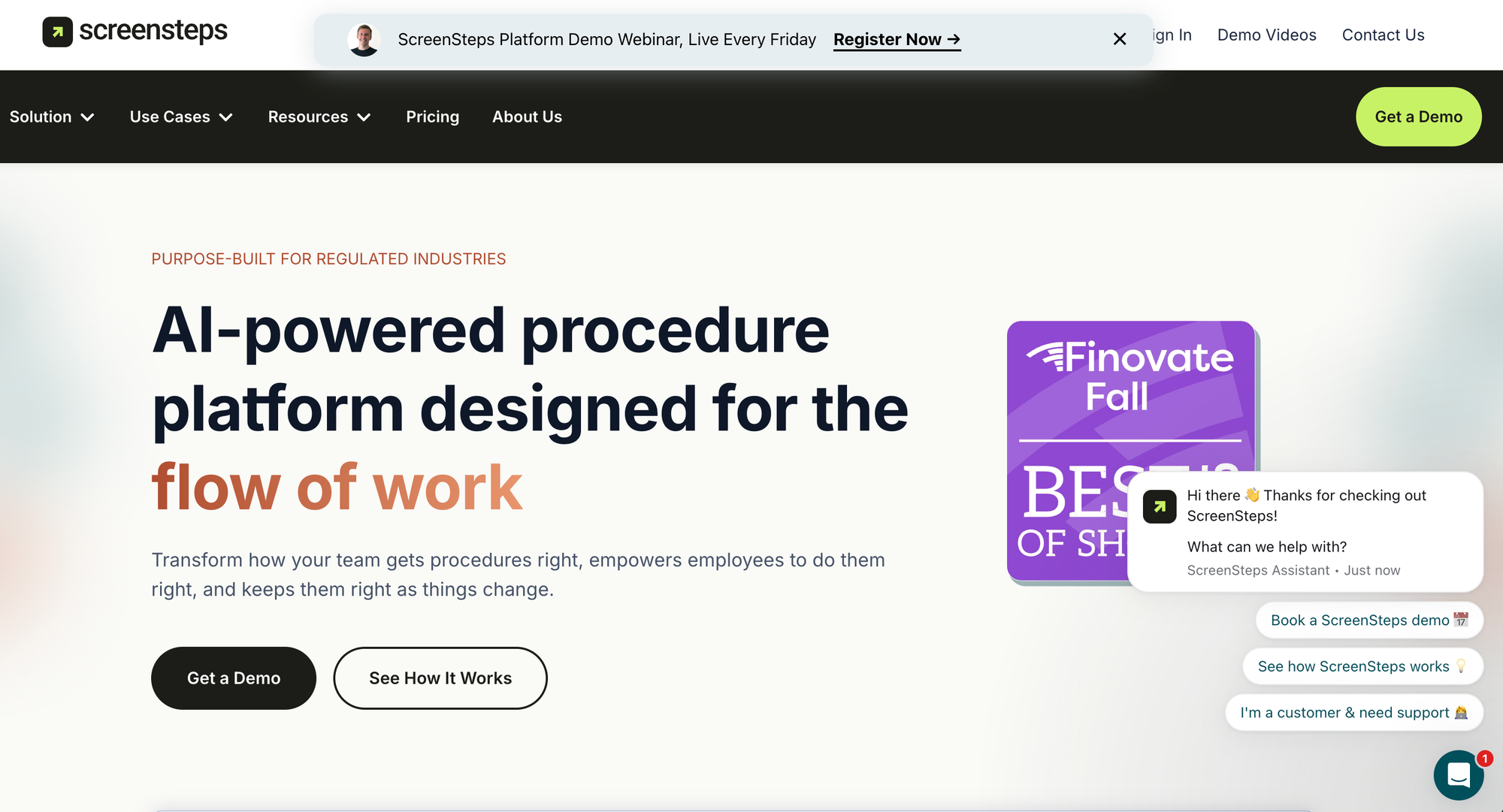
Best for: Credit unions and community banks documenting procedures for branch and back-office staff.
ScreenSteps describes itself as a knowledge operations platform and focuses heavily on financial institutions, with more than 60 of them using the platform. Its approach centers on the “Find & Follow” framework, which pairs a knowledge base with a methodology for turning procedures into guides employees can find and follow on the job.
Key Features for Banks and Credit Unions
- Step-by-step digital guides: Procedures become guides with workflows for decision points and interactive checklists.
- AI-powered authoring: Tools for importing existing documents and capturing knowledge from subject matter experts.
- Browser extension: The Sidekick extension gives access to the knowledge base from any web-based system.
- Change notifications and acknowledgments: Admins can announce updates and require employees to confirm they’ve seen them.
- Courses and learning paths: Training content can be built in the same platform.
Things to Consider
- Built for employees: The platform centers on internal procedures. ScreenSteps offers external knowledge bases through custom plans, but its banking focus is staff guidance, so institutions that want a full customer-facing self-service experience may need another tool.
- Browser-based delivery: Integration with core and digital banking systems generally runs through the browser extension or embedded guides rather than native connections.
- Methodology commitment: Getting full value depends on adopting the Find & Follow framework, which takes training and internal buy-in.
Pricing
ScreenSteps publishes starting prices: Operations Standard starts at $6,000 per year, and Operations AI, which adds the Sidekick extension, AI tools, and courses, starts at $9,000 per year. Enterprise pricing is custom. A 15-day free trial is available.
Bloomfire

Best for: Governing internal policies and procedures.
Bloomfire is an enterprise knowledge management platform with a dedicated credit union offering. It keeps internal policies documented, current, and defensible, from policy creation and approval to staff acknowledgment and audit readiness.
Key Features for Banks and Credit Unions
- Policy governance: Approval workflows, version history, scheduled reviews, and bulk management, with a record of every policy update.
- Staff acknowledgment and knowledge checks: Tracks who has received a policy update and can test whether they understood it.
- Conversational AI: Synapse answers employee questions in plain language with cited answers drawn from approved content.
- Content monitoring: Flags duplicate, conflicting, and outdated content and routes it to owners.
- Search analytics: Shows search patterns, zero-result queries, and content gaps.
Things to Consider
- Internal by design: Bloomfire is built for employee knowledge, so it isn’t designed to serve as a customer-facing help center.
- Not built for in-the-moment guidance: It’s stronger at storing and governing policies than at guiding reps through a procedure during a live interaction.
- Contract structure: Bloomfire reports multi-year billing, with implementation and data migration priced separately.
Pricing
Bloomfire offers custom pricing based on how widely you deploy it: by team, by department, or across the organization.
The Knowledge Platform for Faster, Compliant Banking Service
Stonly gives bank and credit union service teams one platform for rep and customer knowledge.
- Personalized knowledge: Show each rep and customer only the content that applies to their product, account, and situation.
- AI answers and rep assistance: Conversational AI for customer and member self-service and a copilot for reps, both drawing only from approved content.
- Delivery where people already work: Reps get guidance inside the CRM and ticketing system. Customers get relevant content in online and mobile banking through no-code widgets and triggers.
- Knowledge Agents: AI agents that monitor your knowledge, flag what’s outdated or missing, and draft updates for your team to review.
- Procedure adherence and analytics: See which procedures reps follow, step by step and rep by rep.
- Step-by-step guides and process automation: Walk reps through required steps and take actions for them, so procedures stay consistent across every branch.
- A team behind the platform: Product managers and CSMs who have helped more than 1,000 companies succeed with their knowledge.
Request a demo to see how banks and credit unions use Stonly to speed up service, stay compliant, and help more customers and members self-serve.